
Stretch mark treatments in aesthetic medicine: categories, stages, and realistic expectations
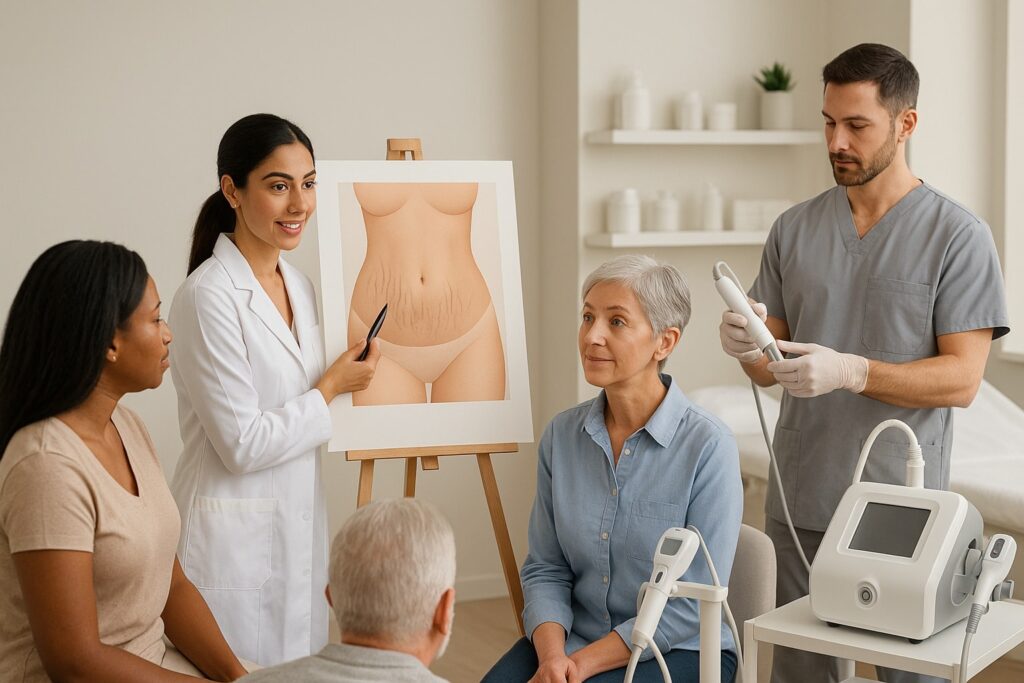
- Stretch mark treatments are rarely limited to one modality; real-world discussions often involve microneedling, lasers, radiofrequency, peels, and combination planning.
- Early red or purple stretch marks and mature white stretch marks are not usually approached the same way, which is why treatment conversations often change by stage.
- Results can vary based on skin type, stretch mark age, treatment category, and individual response, so complete removal should not be assumed.
- For aesthetic professionals, understanding the full treatment landscape supports better patient communication, stronger clinical support, and more informed learning.
- Safety depends on appropriate case selection, practitioner training, device choice, and state-specific scope-of-practice rules in the US.
Stretch mark treatments are one of the most searched and most discussed topics in aesthetic medicine. While stretch marks are not usually a medical emergency, they are a frequent cosmetic concern tied to skin texture, tone, and overall skin quality. In practice, treatment conversations are more complex than many basic overviews suggest.
Instead of focusing on a single option, most aesthetic discussions around stretch marks involve treatment categories, combination approaches, and realistic expectations. That matters for both consumers trying to understand the landscape and aesthetic professionals who want a clearer view of how these concerns are addressed in clinical settings.
What stretch marks are and why treatment planning varies
Stretch marks, also called striae distensae, are dermal changes that develop when the skin stretches beyond what its connective tissue can easily accommodate. They often appear with growth spurts, pregnancy, weight fluctuation, muscle gain, or other factors that affect skin tension and collagen structure.
In aesthetic medicine, stretch marks are typically discussed by stage because appearance and tissue characteristics change over time.
Early red or purple stretch marks
Newer stretch marks are often red, pink, or purple. These early marks are sometimes described as more vascular and active in appearance. In clinical discussions, this stage may lead to different treatment considerations than older stretch marks.
Mature white stretch marks
Older stretch marks often become white, silvery, or lighter than surrounding skin. At this point, texture concerns may become more noticeable, and treatment conversations often shift toward resurfacing, collagen stimulation, and broader skin-quality strategies.
Why stage matters in treatment discussions
The same treatment category may not be discussed in the same way for all stretch marks. Planning can vary based on:
- How long the stretch marks have been present
- Their color and visibility
- Skin type and tone
- Body area involved
- Texture changes
- Overall skin-quality goals
That is one reason broad claims about “the best stretch mark treatment” are usually too simplistic.
Stretch mark treatments commonly discussed in aesthetic medicine
Aesthetic medicine discussions around stretch marks usually include several categories rather than one universal solution.
Microneedling and collagen-induction approaches
Microneedling is one of the most commonly discussed options for stretch marks, especially when the goal is to support texture improvement and collagen remodeling. In educational and clinical conversations, it is often positioned as part of a broader skin-quality plan rather than a standalone answer for every case.
Microneedling discussions may involve:
- Texture-focused treatment planning
- Collagen-induction concepts
- Series-based treatment conversations
- Combination planning with other modalities
Because outcomes vary, it is generally discussed as an improvement-oriented option, not a method that guarantees complete removal.
Microneedling with PRP
PRP may come up in some settings as an adjunct to microneedling. These discussions are often framed around combination planning and tissue-support concepts. Terminology, protocols, and practice patterns vary, and not every clinic uses the same approach.
For educational purposes, the key takeaway is that PRP is often discussed as part of a combined strategy, not as a universal standard.
Radiofrequency and fractional RF microneedling
Radiofrequency-based treatments are another major category in stretch mark treatment discussions. These modalities are often associated with skin tightening and skin-quality improvement conversations.
Standard radiofrequency discussions
In broader aesthetic planning, radiofrequency may be discussed when clinicians are considering:
- Skin laxity and texture concerns
- Non-surgical skin-quality support
- Combination approaches for body areas affected by stretch marks
Fractional RF microneedling
Fractional RF microneedling is often treated as its own category because it combines needling with radiofrequency energy. In aesthetic settings, it is commonly discussed in relation to:
- Texture-focused concerns
- Skin remodeling concepts
- Combination treatment pathways
This treatment category appears frequently in modern stretch mark conversations, especially in clinics that use device-based body rejuvenation approaches.
Laser treatments for stretch marks
Laser-based treatment discussions are a major part of the stretch mark market. However, “laser treatment” is not one thing. Different laser categories may be discussed depending on the stage of the marks, skin tone considerations, downtime tolerance, and treatment goals.
Fractional non-ablative lasers
Fractional non-ablative lasers are often discussed in connection with:
- Skin resurfacing concepts
- Texture-related improvement
- Collagen remodeling discussions
- Lower-downtime treatment planning in some settings
Fractional ablative lasers
Fractional ablative laser discussions may also arise, particularly in more intensive resurfacing conversations. These approaches are usually considered with care because candidacy, recovery, and risk profiles can differ significantly.
Pulsed dye laser for early stretch marks
For earlier red stretch marks, pulsed dye laser may be part of some treatment discussions. This tends to come up more often when vascular appearance is part of the concern. It is not typically framed the same way as resurfacing-focused treatments used for mature white stretch marks.
Chemical peels and resurfacing-related discussions
Chemical peels are also part of the stretch mark conversation, although their role can vary widely by practice style and treatment goals.
Common educational discussions may include:
- Glycolic acid peels
- TCA-related resurfacing concepts
- Superficial peel planning in some settings
Some advanced conversations may also mention higher-intensity peel techniques. Because peel depth, skin tone considerations, and risk management are important, these discussions should be understood within the context of trained professional oversight rather than simplified at-home assumptions.
Other treatment categories that may come up
Many articles stop at microneedling and lasers, but that leaves out categories that are regularly discussed in real aesthetic practice.
Carboxytherapy
Carboxytherapy is sometimes included in stretch mark planning, particularly in clinics that use multimodal body-treatment strategies. Discussions may focus on skin quality and combination use rather than isolated treatment claims.
Biostimulatory treatments
Biostimulatory approaches are relevant because stretch mark conversations often center on collagen support and overall tissue quality. In aesthetic education, this category matters because it reflects a broader trend toward regenerative and skin-quality-focused planning.
Mesotherapy
Mesotherapy-related discussions may appear in some clinics as part of a skin-quality or hydration-oriented approach. Usage patterns vary, and terminology can differ across markets and providers.
Skin boosters and injectable skin-quality discussions
In some advanced settings, skin boosters or other injectable skin-quality treatments may also be part of broader body rejuvenation planning. Product availability, training standards, and scope-of-practice rules vary, so this category is best understood as part of the wider market rather than a universal protocol.
Why combination treatments are so common
One of the most important realities in stretch mark treatment discussions is that combination planning is common. Clinics often do not rely on one modality alone, especially when goals involve both texture and overall skin quality.
Common combination themes may include:
- Microneedling plus PRP
- Laser plus microneedling
- Fractional RF plus biostimulatory planning
- Radiofrequency plus broader skin-quality support
The reason combination approaches appear so often is simple: stretch marks involve multiple visible features, including color, texture, and tissue quality. Different modalities may be discussed to address different aspects of the concern.
This does not mean more treatments always equal better outcomes. It means the market reflects layered treatment planning rather than one-size-fits-all thinking.
Stretch mark treatments by stage: red vs white marks
People often search for the difference between treatment options for red stretch marks and white stretch marks. That is a useful distinction because stage influences what clinicians may prioritize in discussion.
Early red stretch marks
For newer marks, discussions may sometimes focus more on color, vascular appearance, and early intervention concepts. Depending on the practice, this can shape whether energy-based options or other modalities are considered.
Mature white stretch marks
For older white stretch marks, discussions more often center on resurfacing, collagen stimulation, and texture-related planning. These cases are frequently framed as gradual-improvement scenarios rather than quick fixes.
Why this distinction matters
Treating all stretch marks as if they are identical can lead to unrealistic expectations. In both educational content and clinical support roles, it is more accurate to think in terms of stage, skin type, and treatment category.
What results are realistic
Search interest around stretch mark treatments is often driven by one question: “Do they work?” The most credible answer is that results may be meaningful for some patients, but they are variable.
Outcomes can depend on:
- Stretch mark stage
- Skin tone and skin reactivity
- Body area
- Treatment category
- Number and spacing of sessions
- Combination planning
- Individual healing response
Most professional discussions focus on improvement in appearance rather than full elimination. Complete removal should not be promised.
How many sessions are usually discussed
There is no universal number of sessions for stretch mark treatments. Session planning can vary considerably based on the modality, the extent of the concern, and the clinician’s overall approach.
In practice, conversations usually reflect:
- A series-based mindset rather than a one-time expectation
- Reassessment over time
- Possible use of combination treatments
- Gradual improvement rather than instant change
This is another area where realistic expectations are essential.
Who may be considered for stretch mark treatment discussions
Stretch mark treatment conversations may arise for people seeking support with:
- Visible texture concerns
- Skin-quality improvement goals
- Post-pregnancy aesthetic concerns
- Body-area rejuvenation planning
- Combination treatment options
Whether someone is appropriate for a given treatment depends on professional evaluation, medical history, skin type, and other clinical factors. Educational content should not replace a qualified assessment.
Safety considerations and scope of practice in the US
Because this topic sits close to YMYL territory, safety and legal context matter.
Stretch mark treatments are not interchangeable, and safety depends on factors such as:
- Appropriate case selection
- Practitioner training and supervision
- Device choice
- Skin-type considerations
- Proper protocol design
- Adherence to applicable laws and regulations
In the United States, scope of practice can vary by state. That matters for estheticians, medical assistants in support roles, nurses, and other professionals working in aesthetic environments. Not every treatment category may be performed by the same type of provider in every jurisdiction.
For professionals, understanding the market should go hand in hand with understanding supervision requirements, documentation standards, and role boundaries.
Why this topic matters for aesthetic professionals
For learners and professionals in aesthetics, stretch mark treatments are relevant not only because they are common, but because they reveal how real treatment planning works.
A broader understanding of the category can support:
- Clearer patient communication
- Better support during consultations
- More informed treatment preparation
- Smarter comparison of modalities
- Stronger awareness of realistic outcomes
- Better recognition of when combination planning is being discussed
In other words, understanding stretch mark treatments is not just about memorizing devices or buzzwords. It is about learning how aesthetic concerns are assessed, how expectations are framed, and how multiple treatment categories fit into modern practice.
Build a stronger understanding of aesthetic treatment planning
If you want to better understand how concerns like stretch marks are discussed in modern aesthetic settings, Eduasthetics offers educational content designed to help learners and professionals build practical, market-relevant knowledge with a clear, responsible approach.
Sources and references
- American Academy of Dermatology. Guidance on stretch marks and treatment expectations.
- American Society for Dermatologic Surgery. Educational resources on skin resurfacing and aesthetic treatment modalities.
- Journal of Clinical and Aesthetic Dermatology. Review literature on striae distensae and aesthetic treatment options.
FAQS
What are the most commonly discussed stretch mark treatments in aesthetic medicine?
The most commonly discussed categories include microneedling, radiofrequency-based treatments, fractional RF microneedling, laser treatments, chemical peels, and combination approaches. Some clinics also discuss PRP, carboxytherapy, mesotherapy, biostimulatory treatments, and skin-quality injectables.
Are stretch mark treatments different for red vs white stretch marks?
Often, yes. Early red or purple stretch marks and mature white stretch marks are not usually approached in exactly the same way. Treatment discussions may vary based on vascular appearance, texture, and the age of the marks.
Are laser treatments commonly used for stretch marks?
Laser treatments are a major part of stretch mark discussions in aesthetic medicine. The category includes different technologies, and the choice of approach can vary based on skin type, stretch mark stage, downtime considerations, and clinician preference.
Is microneedling commonly discussed for stretch marks?
Yes. Microneedling is one of the most frequently discussed options, especially in relation to skin texture and collagen-induction concepts. It is also commonly mentioned as part of combination treatment planning.
Are combination treatments common for stretch marks?
Yes. Combination planning is common because stretch marks can involve multiple concerns at once, including color, texture, and skin quality. Different modalities may be discussed to address different treatment goals.
Can stretch marks be completely removed?
Complete removal should not be assumed. Most credible discussions focus on possible improvement in appearance rather than total erasure. Results vary by stage, skin type, treatment category, and individual response.
How many sessions do stretch mark treatments usually require?
There is no universal number. Treatment planning often involves a series of sessions, reassessment over time, and sometimes combined modalities rather than a single appointment.
Why should aesthetic professionals learn more than one treatment category?
Because real-world practice rarely centers on one modality alone. A broader understanding helps professionals support consultations, communicate more clearly, and better understand how clinicians build treatment plans.
Related posts
Hair removal vs epilation: what’s the difference in aesthetics?
Stay Updated
About de author
