
Aesthetic device maintenance: safe use and equipment care in med spas
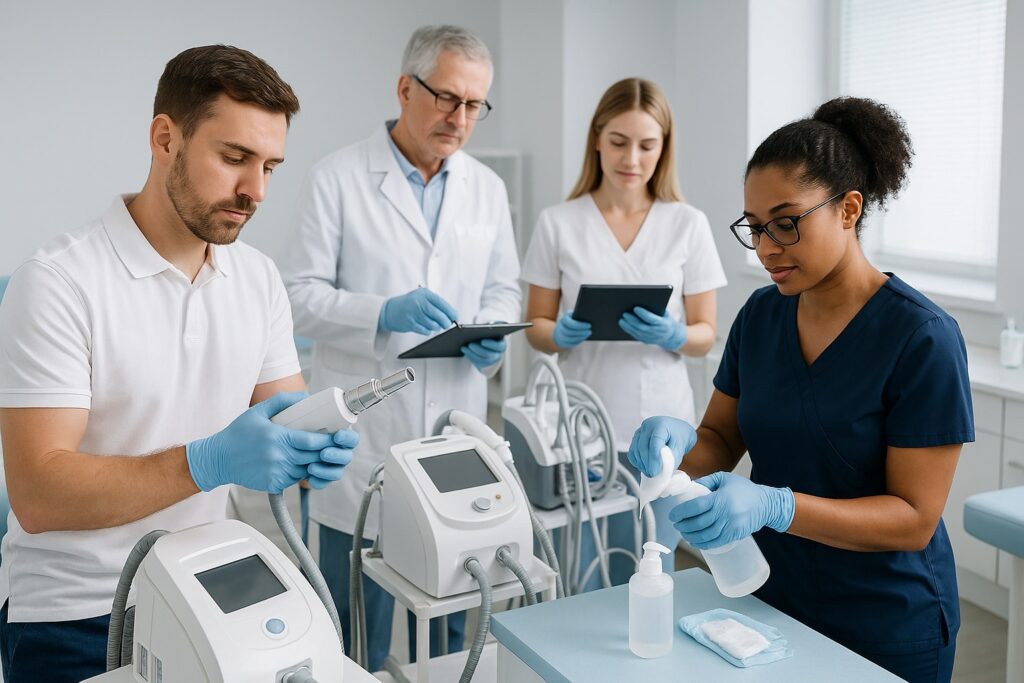
- Aesthetic device maintenance supports three essentials in a clinical setting: patient safety, treatment consistency, and equipment lifespan.
- The most common equipment risks come from skipped cleaning, worn accessories, poor documentation, overheating, and using devices outside manufacturer instructions.
- Safer day-to-day use depends on routine visual checks, proper cleaning and disinfection, preventive service, and clear incident reporting.
- Responsibility is usually shared across licensed clinicians, trained support staff, and qualified technical service providers, with role limits shaped by state law and clinic policy.
- Training matters because safe device use is not just about the machine itself. It also depends on judgment, protocol adherence, hygiene awareness, and knowing when a device should not be used.
In medical aesthetics, equipment care is not a back-office task. It is part of safe clinical practice. Whether a clinic uses laser platforms, radiofrequency systems, ultrasound devices, or facial treatment equipment, maintenance affects how consistently a device performs and how safely it fits into everyday workflow.
For professionals, students, and support staff in med spas and aesthetic clinics, understanding aesthetic device maintenance means more than knowing how to switch a machine on. It means recognizing warning signs, following cleaning protocols, documenting service history, and respecting the boundaries of each device’s intended use.
Why aesthetic device maintenance matters in medical aesthetics
Many aesthetic treatments rely on devices that interact directly with the skin through heat, light, suction, ultrasound, or other application systems. Even when a device appears to be functioning normally, hidden issues such as wear, residue buildup, or overdue servicing can affect performance.
Proper maintenance helps support:
- More consistent treatment delivery
- Better hygiene control
- Stronger adherence to manufacturer instructions
- Better documentation and traceability
- Reduced risk of avoidable device-related problems
- Longer useful life for expensive equipment
This is especially important in medical aesthetics, where workflow often depends on multiple accessories, handpieces, cables, filters, tips, and consumables. A device is only as reliable as the condition of the full system around it.
What can go wrong when equipment is poorly maintained
Poor maintenance does not always lead to immediate failure. In many cases, the warning signs show up gradually through inconsistency, unexpected errors, or workflow disruptions.
Treatment inconsistency and unreliable performance
When equipment is overdue for service or shows signs of wear, treatment delivery may become less predictable. That can create problems such as:
- Inconsistent energy output
- Reduced applicator performance
- Error messages during treatment
- Intermittent function issues
- Variability between sessions
Even minor performance changes matter in an aesthetic setting, where consistency is part of professional quality and patient trust.
Hygiene and cross-contamination concerns
Reusable equipment, contact surfaces, and accessories must be handled carefully. If visible residue is left behind, or if cleaning and disinfection steps are rushed, hygiene standards can be compromised.
Common concerns include:
- Residue left on handpieces or treatment surfaces
- Improper separation of clean and used items
- Reuse of materials intended for single use
- Inadequate processing of reusable components
- Incomplete turnover between patients
In a busy med spa, these risks often come from workflow failures rather than bad intent, which is why clear protocols matter.
Overheating, wear, and unplanned downtime
Aesthetic devices are also vulnerable to environmental and mechanical stress. Poor ventilation, blocked filters, repeated cable strain, and delayed replacement of worn parts may contribute to:
- Excess heat buildup
- Reduced device efficiency
- Premature component failure
- Unexpected cancellations or downtime
- Costly repairs that may have been preventable
For clinics, this is not just a technical issue. It also affects scheduling, patient experience, and operational reliability.
Core maintenance practices for aesthetic devices
Strong equipment care usually comes down to consistent habits, not complicated systems. The basics are often what make the biggest difference.
Clean and disinfect after every use
After each treatment, device surfaces and accessories should be cleaned and disinfected according to the manufacturer’s instructions and the clinic’s internal protocols.
One principle is especially important: visible debris should be removed before disinfection. If product residue, gel, or soil remains on the surface, the disinfection step may be less effective.
This process should include attention to:
- Handpieces
- Contact surfaces
- Cords and touch points
- Reusable accessories
- Stands, trays, or nearby surfaces touched during treatment
Cleaning expectations may differ by device, material, and intended use, so staff should avoid improvising.
Inspect the device before and after use
A quick visual check can help catch problems early. Before using a device, it is smart to look for signs of wear or damage involving:
- Cables and connectors
- Handpieces and applicators
- Filters and vents
- Screens and control panels
- Attachments and consumables
- Cracks, fraying, residue, or loose parts
After use, the same inspection can help identify issues that need to be logged or addressed before the next appointment.
If a device shows visible damage, repeated error messages, unusual sounds, or possible overheating, it should be removed from use until it has been properly evaluated under the clinic’s process.
Follow the manufacturer’s instructions for use
Safe use starts with respecting the device’s intended design. Each system has its own limits, approved accessories, maintenance schedule, and use conditions.
That includes areas such as:
- Compatible consumables
- Cleaning products approved for the device
- Storage requirements
- Ventilation needs
- Service intervals
- Warnings and contraindication-related labeling
Using a device outside its intended operating conditions can create avoidable risk and may also complicate traceability when problems occur.
Keep preventive maintenance on schedule
Preventive maintenance is what helps clinics catch issues before they affect treatment flow. Depending on the device type, this may include:
- Scheduled service reviews
- Calibration where applicable
- Replacement of worn accessories or parts
- Electrical safety checks
- Ventilation and environmental checks
- Tracking recurring faults or service events
Aesthetic practices often focus heavily on treatment scheduling, but a solid preventive maintenance calendar is just as important to safe operations.
Document maintenance and incident history
Documentation is often the difference between a well-managed device issue and a repeated one.
Useful records may include:
- Routine maintenance logs
- Service provider reports
- Incident reports
- Replacement dates for consumables or accessories
- Notes on repeated errors or performance concerns
- Dates when a device was removed from service and cleared to return
Good records support accountability, internal review, and safer decision-making.
Maintenance considerations by device category
Not all aesthetic equipment creates the same maintenance priorities. The type of device influences what staff should watch for.
Energy-based devices
Laser, light-based, ultrasound, and radiofrequency systems typically require careful attention to performance integrity and heat-related safety features.
Maintenance considerations often include:
- Applicator and handpiece condition
- Contact surface integrity
- Cooling or thermal management components
- Vent and filter cleanliness
- Safety features and warning systems
- Calibration or technical checks when required by the manufacturer
Because these systems interact with tissue through controlled energy delivery, performance consistency matters.
Injection-related equipment and single-use materials
Where treatment settings involve injection-related tools or supporting materials, safe handling becomes especially important. Priority areas may include:
- Clear separation between reusable and single-use items
- Proper handling and disposal of sharps
- Storage and organization that reduces handling errors
- Processing reusable items only according to validated protocols where applicable
In the United States, injection-related tasks may be restricted by licensure, delegation rules, and state law. Educational content on equipment care should never be read as permission to perform activities outside legal scope of practice.
Facial and body treatment devices
Frequently used facial and body systems may be exposed to heavy daily wear, especially in high-volume med spas. Common issues include:
- Cable strain from repeated movement
- Microdamage to applicators
- Product residue around connection points
- Ventilation blockage
- Wear to attachments and treatment heads
These devices often benefit from disciplined opening and closing routines, so wear patterns are noticed before they become failures.
Who is responsible for equipment safety in a US practice
Equipment care is usually a shared responsibility, not a one-person job. A safe system depends on clear task boundaries and a process everyone understands.
Licensed clinicians and medical oversight
Depending on the setting and the device, licensed professionals may be responsible for:
- Establishing or approving clinical use protocols
- Setting safety expectations
- Determining when a device should be taken out of service
- Reviewing incidents that could affect patient safety
- Confirming that use aligns with professional and regulatory boundaries
The exact structure varies by practice model and state requirements.
Support staff and delegated responsibilities
Trained support personnel may help with operational tasks such as:
- Room and device preparation
- Cleaning and disinfection
- Visual inspection
- Stock control for consumables
- Reporting visible damage or recurring issues
- Supporting documentation and workflow
In the US, support staff responsibilities can vary significantly by state, employer policy, supervision requirements, and job title. Training should always match the legal and operational boundaries of the role.
Qualified technical service providers
Some maintenance tasks should only be handled by qualified service professionals. This may include:
- Repairs
- Specialized testing
- Technical verification
- Calibration when applicable
- Replacement of internal components
Clinics should also have a clear process for deciding who can authorize a device’s return to service after an issue has been evaluated.
A practical daily workflow for safer equipment handling
A clinic does not need a complicated system to improve equipment safety. It needs a repeatable one.
A strong daily workflow often includes:
- Confirming staff training before a new device or accessory is used
- Checking the device before patient use
- Verifying that the correct accessories and consumables are available
- Cleaning and disinfecting the device after use
- Logging abnormalities, incidents, or repeated faults
- Removing questionable equipment from service promptly
- Storing devices under appropriate environmental conditions
- Confirming scheduled maintenance is not overdue
These habits help reduce preventable mistakes and improve consistency across staff shifts.
Why training matters for aesthetic device safety
Aesthetic device safety depends on more than operating instructions. It also depends on human judgment.
Training helps professionals and support staff understand:
- The limits of a device
- Why protocols must be followed consistently
- Basic hygiene and infection-prevention principles
- What abnormal device behavior looks like
- When a treatment should be paused because equipment concerns are present
- How and when to escalate an incident internally
For estheticians, medical aesthetic assistants, and other support roles, this knowledge can strengthen patient communication and improve clinical support without crossing into tasks outside scope.
Scope of practice matters in the United States
One of the most important US-specific considerations is that scope of practice is not uniform nationwide. The same task may be allowed in one setting and restricted in another, depending on:
- State law
- Licensure
- Medical supervision requirements
- Facility policy
- The type of treatment or device involved
That is why education in this area should focus on safe systems, role awareness, and responsible escalation rather than assumptions about who can perform which tasks.
What to look for before choosing or using equipment in a professional setting
For students, new staff, or clinic managers reviewing equipment processes, a few questions are especially useful:
- Is there a documented maintenance schedule?
- Are cleaning and disinfection instructions easy for staff to access?
- Is there a service history for the device?
- Are accessories clearly labeled and stored correctly?
- Do staff know what signs require the device to be removed from service?
- Is responsibility for reporting and documentation clearly assigned?
- Are training records current for the people using or handling the device?
These questions do not replace technical evaluation, but they do help reveal whether a clinic has a safer, more accountable equipment culture.
Sources and references
- Centers for Disease Control and Prevention. Guideline for disinfection and sterilization in healthcare facilities.
- U.S. Food and Drug Administration. Medical device safety and device labeling guidance.
- Occupational Safety and Health Administration. Bloodborne pathogens and sharps safety.
FAQS
Why is aesthetic device maintenance so important?
Because it supports safer care, more consistent treatment performance, and better equipment reliability. In a med spa or aesthetic clinic, maintenance is part of the treatment safety system, not a separate administrative task.
How often should aesthetic devices be serviced?
There is no single schedule that fits every device. Service frequency depends on the manufacturer’s recommendations, the type of equipment, how often it is used, and the clinic’s internal maintenance plan.
What should staff do if a device shows an error message or unusual heat?
The safest general approach is to stop using the device and follow the clinic’s reporting process. Repeated errors, unusual sounds, visible damage, or overheating concerns should be evaluated before the device returns to use.
Can support staff clean and inspect aesthetic equipment?
In many settings, trained support staff may assist with cleaning, preparation, visual inspection, and documentation. However, role boundaries depend on state law, employer policy, and the type of device involved.
Do all aesthetic devices need calibration?
Not always. Some devices may require calibration or other technical verification based on manufacturer guidance, while others may rely on different maintenance checks. The correct standard should come from the device instructions and qualified servicing requirements.
What is the difference between cleaning and disinfection?
Cleaning removes visible soil and residue. Disinfection is a separate step intended to reduce microbial contamination on appropriate surfaces. In practice, both steps matter, and disinfection is less reliable when cleaning has been skipped.
When should a device be taken out of service?
A device should be reviewed when there are signs such as visible damage, repeated malfunctions, overheating, unusual noises, damaged accessories, or unresolved performance concerns. Clinics should have a written process for removing equipment from service and documenting what happens next.
Is equipment safety part of aesthetics education?
Yes. Quality education in medical aesthetics often includes foundational knowledge about device safety, hygiene, workflow, documentation, and professional role boundaries, especially for people supporting treatment environments.
Related posts
Infection control in medical aesthetic clinics: essential safety protocols for estheticians and assistants
How to build a resume for medical aesthetic assistant jobs in the U.S.
How to handle difficult patients in a medical aesthetics clinic
Stay Updated
About de author
