
Coconut oil for hair: benefits, best uses, and when to use caution
Home › Hair, Body & Specialty Aesthetics › Hair Restoration & Scalp Health › Hair Care & Topicals
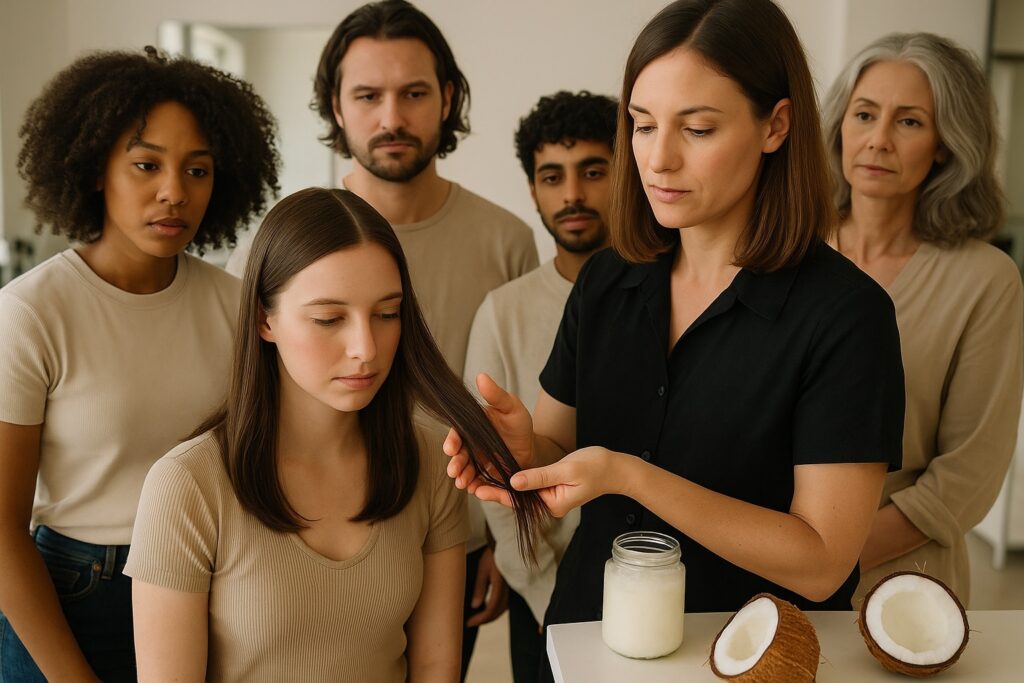
- Coconut oil for hair may help reduce roughness, improve shine, and support frizz control in some hair types, especially hair that feels dry, porous, or textured.
- Its role is mainly cosmetic and supportive. It does not permanently repair damaged hair, treat hair loss, or replace care for scalp disorders.
- Fine, straight, or oil-prone hair may feel weighed down more easily, and overuse can leave buildup or a dull finish.
- Common ways people use it include pre-shampoo treatments or very small amounts on mid-lengths and ends rather than heavy all-over application.
- Results vary based on strand thickness, porosity, curl pattern, scalp condition, cleansing habits, and the rest of the hair routine.
What coconut oil for hair actually does
Coconut oil remains popular because it can change how hair looks and feels in a noticeable way for some people. In everyday hair care, it is most often used to support softness, manageability, and a smoother surface.
That said, it helps to be realistic about what “benefit” means here. Coconut oil is generally discussed as a cosmetic hair care ingredient, not as a treatment for medical hair or scalp conditions.
In practical terms, coconut oil may help with:
- dry-feeling hair
- surface roughness
- frizz in some hair types
- cosmetic shine
- friction from brushing, styling, and daily manipulation
Some research has also helped explain why coconut oil is discussed differently from many other oils. It does not behave exactly the same way on the hair fiber as every surface oil does, which may be one reason some users report better softness or less roughness with it.
Support for dry-feeling hair
Hair that feels dry often looks dull, tangles more easily, and has less slip between strands. Coconut oil may help some hair types feel softer and smoother, which can make styling easier.
This does not mean the hair has been “healed.” It means the hair may be better coated or supported cosmetically, so it feels less rough.
Help with frizz and flyaways
For some people, especially those with curls, waves, or more porous strands, coconut oil may help reduce the appearance of frizz. It can also improve visual definition and leave the hair looking smoother.
The key phrase is “for some people.” Hair texture, climate, and product layering all affect the result. On the wrong hair type, coconut oil can make hair look limp instead of polished.
Reduced friction during routine styling
Hair does not only break because of chemicals or heat. It also experiences wear from brushing, tying, rubbing against fabric, or repeated handling.
Some people use coconut oil as part of a routine intended to reduce friction between strands or improve slip during styling. That may help support lower mechanical breakage in some cases, though it should not be seen as a complete solution on its own.
Who may benefit most from coconut oil
Not every hair type responds the same way. That is one reason online opinions about coconut oil can sound completely contradictory. One person describes it as essential, while another says it made their hair greasy or stiff.
Both experiences can be true.
Dry or porous hair
Hair that loses moisture easily or feels rough shortly after washing may be more likely to tolerate richer oils. In these cases, coconut oil is often used to improve softness and reduce a dry, coarse feel.
Porous hair may also be more prone to frizz and swelling in humidity, which helps explain why some people turn to oils as a finishing or protective step.
Curly, coily, or textured hair
Textured hair routines often include richer creams, butters, or oils because many of these hair types benefit from products that help support moisture retention and reduce tangling.
Coconut oil is often part of those discussions because some textured hair types can handle it well. It may help with:
- softness
- definition
- smoother-looking ends
- less visible frizz
Still, textured hair is not one category. Curl pattern, density, porosity, and product layering all matter.
Heat-exposed or chemically stressed hair
Hair that has been repeatedly blow-dried, flat ironed, lightened, or chemically processed often feels more fragile and rough. In those situations, some people use coconut oil as supportive care to improve feel and appearance.
What it does not do is reverse structural damage. If hair has been significantly compromised, coconut oil may improve manageability, but it does not rebuild hair back to its original state.
When coconut oil may not be the right fit
Coconut oil is often described as a universal beauty staple, but it is not universally useful. Some hair types do better with lighter oils or different conditioning strategies.
Fine or low-volume hair
People with fine hair often notice heaviness quickly. Even a small amount of coconut oil may make the hair feel coated, flatter, or harder to style.
If volume is a priority, heavier oils can work against that goal.
Straight hair that gets oily easily
Straight hair can sometimes show oil more visibly than textured hair. Coconut oil may travel or spread in a way that leaves strands looking greasy faster, especially if too much is applied near the roots.
For this hair type, a tiny amount on the ends may be more workable than all-over use.
Buildup and a dull finish
Yes, coconut oil can contribute to buildup. This is one of the most common complaints from people who try it and dislike the result.
Buildup risk depends on:
- how much is used
- how often it is used
- whether it is layered with other products
- how thoroughly the hair is cleansed
- the natural tendency of the hair to feel heavy or coated
More product is not automatically better. In many cases, coconut oil works best when used sparingly.
Sensitive scalp or active scalp concerns
Coconut oil discussions often focus on the hair shaft, but scalp concerns are different. If someone has persistent itching, redness, flaking, irritation, or other ongoing scalp symptoms, a general beauty remedy may not be the right answer.
Coconut oil should not be viewed as treatment for dandruff, dermatitis, scalp inflammation, or other scalp disorders. When symptoms persist or worsen, professional evaluation is more appropriate than trial-and-error product use.
How people commonly use coconut oil in a hair routine
There is no single “correct” way to use coconut oil. Tolerance varies a lot, and method matters just as much as ingredient choice.
Pre-shampoo use
One common approach is using coconut oil before washing. This method appeals to people who want the supportive feel of the oil without leaving a heavy residue in the hair afterward.
Pre-shampoo use is often considered more manageable than saturating the hair and leaving it in regularly, especially for finer hair types.
A small amount on mid-lengths and ends
Another common use is applying a very small amount to the mid-lengths or ends to smooth the look of the hair and control flyaways.
This is where people often run into problems: the difference between “enough” and “too much” can be very small.
Overnight masks
Overnight coconut oil masks are widely discussed online, but they are not a good fit for everyone. Some people wake up with softer hair, while others end up with residue, limpness, or hair that needs multiple washes.
The richer the oil and the finer the hair, the more likely overnight use may feel excessive.
Coconut oil for heat-damaged hair: what to expect
This topic deserves clear expectations because coconut oil is often overpromoted in damage-related conversations.
If hair has been stressed by hot tools, repeated blow-drying, bleach, or chemical processing, coconut oil may help it feel smoother, less rough, and somewhat easier to manage. That can be meaningful from a cosmetic standpoint.
What it does not mean:
- it does not reverse structural heat damage
- it does not “seal” split ends permanently
- it does not replace broader damage-control habits
- it does not make damaged hair the same as healthy, untreated hair
Supportive care matters, but realistic expectations matter just as much.
Coconut oil vs other popular hair oils
People rarely search coconut oil in isolation. They often want to know how it compares with other oils they have seen online or in beauty content.
Coconut oil vs argan oil
This is one of the most common comparisons.
In general discussions, coconut oil is often associated with richer support for dry-feeling or rough hair. Argan oil is often described as lighter-feeling and more finish-oriented, especially when the goal is shine or smoothing without as much heaviness.
Neither is universally better. The better choice depends on:
- hair thickness
- texture
- how much buildup the hair tends to get
- whether the goal is softness, shine, or frizz control
- how much product the hair can tolerate
Coconut oil vs rosemary oil
These oils are often confused in online beauty conversations, but they are usually discussed for different reasons.
Coconut oil is mostly part of hair fiber and cosmetic care conversations. Rosemary oil is more often mentioned in scalp-focused discussions.
They are not direct substitutes, and they should not be treated as though they serve the same purpose.
What coconut oil does not do
One of the most helpful things in hair education is separating common use from exaggerated claims.
Coconut oil does not:
- permanently repair damaged hair
- treat hair loss
- serve as an established hair-growth treatment
- treat scalp disease
- replace professional evaluation for significant shedding or persistent scalp symptoms
This point is especially important because hair concerns can overlap with medical, hormonal, inflammatory, or nutritional issues. A cosmetic oil should not be framed as a stand-in for proper assessment when a problem is ongoing or significant.
Why results vary so much from person to person
Hair care advice often fails because it treats all hair as if it behaves the same way. It does not.
Response to coconut oil may depend on:
- strand thickness
- hair density
- porosity
- curl pattern
- level of previous heat or chemical stress
- climate and humidity
- scalp oiliness
- how often the hair is washed
- how many other products are already being used
That is why a product can be helpful in one routine and disappointing in another. Context matters more than trends.
Why ingredient literacy matters in beauty education
For students, beauty professionals, and informed consumers, coconut oil is a useful example of why ingredient literacy matters.
A good hair care discussion should distinguish between:
- cosmetic support and medical treatment
- improved appearance and true structural repair
- scalp care and hair fiber care
- social media claims and evidence-aware expectations
That kind of distinction is valuable well beyond coconut oil. It helps build more responsible, realistic decision-making across hair, skin, and aesthetic education.
Learn more with Eduasthetics
If you value clear, evidence-aware beauty education, explore more resources from Eduasthetics. We publish practical content designed to help readers better understand ingredients, treatments, and aesthetic care topics without hype or overstatement.
Sources and references
- American Academy of Dermatology Association. Hair care tips and guidance for healthy hair.
- Cleveland Clinic. General hair care and hair oil education.
- Rele AS, Mohile RB. Effect of mineral oil, sunflower oil, and coconut oil on prevention of hair damage. Journal of Cosmetic Science.
FAQS
Is coconut oil good for every hair type?
No. It may work well for some dry, porous, curly, or textured hair types, but fine, straight, or oil-prone hair may find it too heavy.
Can coconut oil help with frizz?
It can help some people reduce the look of frizz and flyaways, especially when dryness or porosity is part of the issue. Results vary by hair type and how much is used.
Can coconut oil help heat-damaged hair?
It may improve softness and manageability in hair that has been exposed to heat, but it should not be viewed as a way to reverse structural damage.
Does coconut oil help hair grow?
It should not be presented as an established hair-growth treatment. If someone is concerned about thinning or increased shedding, that is a separate issue from cosmetic oil use.
Can coconut oil cause buildup on hair?
Yes. Buildup is a common concern, especially when too much is used, the hair is fine, or cleansing is not sufficient to remove residue.
Is coconut oil better than argan oil for hair?
Not across the board. Coconut oil is often discussed as richer and heavier, while argan oil is often described as lighter and more finish-focused. The better option depends on the hair type and goal.
Is coconut oil safe for color-treated hair?
Some people include it in routines for color-treated hair, but results vary. If hair is already fragile or easily weighed down, a lighter approach may work better.
Related posts
Female hair transplant: how hair restoration works for women
Common types of alopecia and how to tell them apart
Gray hair and cancer: what new research actually suggests
Stay Updated
About de author
