
Gray hair and cancer: what new research actually suggests
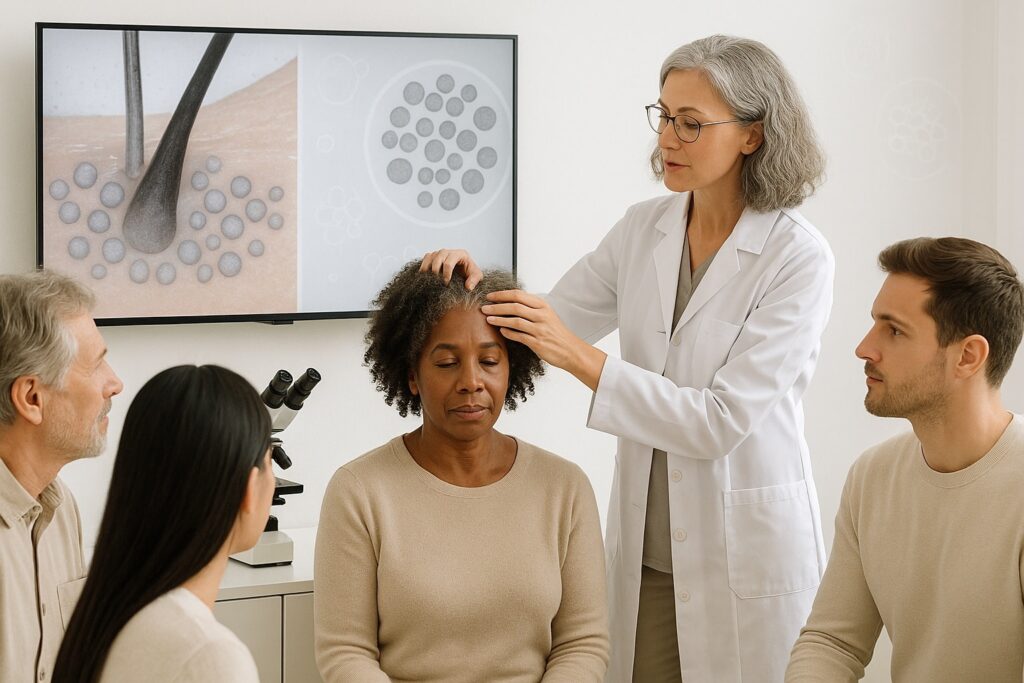
- New laboratory research has explored whether stress responses in pigment-related stem cells may help explain both hair graying and certain pathways involved in melanoma biology.
- The study does not show that gray hair prevents cancer, lowers melanoma risk, or works as a reliable health marker.
- Hair graying is still most commonly linked to aging, genetics, oxidative stress, and changes in the cells that support pigment production.
- For hair, scalp, and aesthetic professionals, the key takeaway is scientific accuracy: this is an interesting research development, not a clinical conclusion.
- The topic is worth watching, but it needs more validation, including human research, before stronger claims can be made.
Why gray hair and cancer are being discussed together
Gray hair usually enters the conversation as a normal sign of aging. But recent research has drawn attention for a different reason: scientists are studying whether the loss of hair pigment may sometimes reflect how certain stem cells respond to stress and genetic damage.
That has led to headlines suggesting a possible connection between gray hair and cancer biology. The idea is not that gray hair is “good” or that it protects people from disease. Rather, researchers are looking at whether visible pigment loss might reveal something about how cells behave when they are under pressure.
This distinction matters. Early-stage biological research can be fascinating, but it should not be turned into health advice or simplified into dramatic claims.
The role of pigment-related stem cells
Hair color depends on melanin, the pigment produced by melanocytes. Inside the hair follicle, melanocyte-related stem cells help replenish the pigment-producing system over time.
When that system becomes depleted, disrupted, or less efficient, hair may begin to turn gray or white. Researchers are interested in these cells because they sit at the intersection of several important biological processes, including:
- aging
- oxidative stress
- DNA damage responses
- stem cell exhaustion
- cellular signaling changes
In research settings, scientists have explored whether stressed pigment-related stem cells may move toward different biological outcomes, including pigment loss.
Why melanoma is part of the conversation
Melanoma is a cancer that develops in melanocytes, the same broad family of pigment-producing cells involved in skin and hair pigmentation. Because both gray hair and melanoma involve pigment biology, researchers are studying whether some of the same cellular stress pathways may be relevant in both contexts.
That does not mean gray hair predicts melanoma or reduces melanoma risk. It simply means there may be shared biological territory worth studying more closely.
How hair turns gray in the first place
For most people, gray hair is primarily a feature of aging and genetics. Over time, the follicle’s pigment system becomes less active, and the hair shaft grows with less melanin. The result is gray, silver, or white hair.
This process is common and usually gradual. It does not automatically indicate a medical problem.
Common factors linked to gray hair
Several influences are commonly associated with hair graying:
- Age: Pigment production tends to decline over time.
- Genetics: Family history plays a major role in when graying begins.
- Oxidative stress: Researchers continue to study how oxidative damage may affect the follicle environment.
- Stem cell depletion: Reduced function or loss of pigment-related stem cells can contribute to graying.
- Cell signaling changes: The pathways that regulate hair growth and pigmentation may shift with age and stress.
In other words, gray hair is not a one-cause phenomenon. It is the result of overlapping biological processes, which is part of why the research remains complex.
What the current research does not prove
This is the section many readers need most. No matter how eye-catching the headlines may sound, current evidence does not support the following claims:
- Gray hair protects against cancer
- Gray hair lowers melanoma risk
- Gray hair works as a disease screening tool
- People with gray hair have a stronger natural defense against cancer
- White or gray hair should be interpreted as a reliable biomarker of cellular protection
These claims go beyond what the science currently shows.
The recent research is valuable because it opens new questions about pigment biology, stress responses, and stem cell behavior. That is very different from proving a health benefit.
Why overinterpreting the findings is risky
Sensational health messaging can distort legitimate science. When early research gets turned into simplified claims, readers may walk away with the wrong impression.
In this case, the risk is that people may confuse a laboratory finding with a real-world clinical conclusion. That can create false reassurance, poor health assumptions, or unnecessary anxiety.
For educational content in aesthetics and hair science, the responsible approach is to separate:
- what researchers are investigating
- what has been observed in experimental models
- what has actually been proven in humans
Those are not the same thing.
Why this research matters for aesthetic and hair professionals
Even when a finding is preliminary, it can still matter from an educational standpoint. Professionals working in scalp health, hair restoration, medical aesthetics, dermatology-adjacent support roles, and patient education often get questions about visible changes such as premature graying, thinning, pigment loss, and aging-related appearance changes.
Understanding the science at a high level can help professionals:
- explain gray hair in a more informed way
- avoid repeating exaggerated claims
- recognize the difference between emerging research and established evidence
- communicate more confidently in educational or client-facing settings
This is especially relevant in medical aesthetics, where clients often connect visible changes with broader health concerns.
A responsible way to discuss gray hair research
A balanced explanation might sound like this:
- Gray hair is usually part of normal aging and genetics.
- Researchers are studying how cellular stress affects pigment-related stem cells.
- Some of that science overlaps with melanoma biology because both involve pigment-producing cells.
- The research is interesting, but it does not mean gray hair prevents cancer.
That framing is accurate, clear, and far more useful than repeating a simplified headline.
When general awareness matters
Aesthetic and hair professionals are not diagnosing cancer, but they do play a role in observation and education. If a client raises concerns about unusual scalp or skin changes, new pigmented lesions, or evolving spots, the appropriate step is to encourage evaluation by a qualified medical professional.
That is not because gray hair is dangerous. It is because visible changes involving pigment can sometimes raise questions that belong in a medical setting, not an aesthetic one.
What researchers may study next
The most important next step is stronger evidence. For this area of science to move beyond theory and early biological insight, researchers will need to better understand:
- whether the same mechanisms seen in experimental models apply in humans
- how melanocyte stem cells behave over time under different stress conditions
- which molecular pathways are truly shared between hair graying and melanoma-related processes
- whether any visible hair changes could ever have meaningful clinical relevance
At this stage, the most accurate view is simple: the research is promising as a scientific question, not as a conclusion.
What this means for readers right now
For most readers, the practical takeaway is modest but useful. Gray hair remains, first and foremost, a common feature of aging and biology. The newer research does not change that.
What it does change is the level of scientific curiosity around hair pigmentation. Hair follicles are increasingly being studied as windows into aging, stress biology, and stem cell behavior. That makes gray hair a more interesting research topic than many people assumed.
Still, interest should not be confused with proof. If you work in aesthetics, scalp care, or hair education, the best approach is to treat this topic as emerging science worth following, while avoiding broad health claims that are not supported by current evidence.
Learn with a stronger foundation in aesthetic science
Eduasthetics provides educational content designed to help professionals build clearer, safer, and more evidence-aware understanding of topics across medical aesthetics, skin, hair, and patient-facing practice. Explore training and learning resources that turn complex subjects into practical knowledge.
Sources and references
- Mohri Y, et al. Antagonistic stem cell fates under stress govern decisions between hair greying and melanoma. Nature Cell Biology.
FAQS
Does gray hair protect against cancer?
No. Current research does not show that gray hair protects against cancer or reduces melanoma risk.
Why are researchers linking gray hair and melanoma?
Both involve pigment-related cells. Scientists are studying whether some of the same stress and stem cell pathways may play a role in both hair graying and melanoma biology.
Is gray hair a sign of DNA damage?
Not by itself. Hair graying is influenced by multiple factors, including aging, genetics, oxidative stress, and changes in pigment-related stem cells. It is not a standalone marker of disease.
Can stress make hair turn gray?
Research suggests stress may affect the biology of hair pigmentation, but graying is multifactorial. Age and genetics still play major roles.
Is early graying a reliable sign of a health problem?
Usually not. Early graying can happen for many reasons and is not considered a reliable disease marker on its own.
Should aesthetic professionals describe gray hair as a natural defense mechanism?
No. That framing overstates the science. A more accurate explanation is that researchers are exploring how stressed pigment-related cells behave, but no protective effect has been established.
Related posts
Female hair transplant: how hair restoration works for women
Common types of alopecia and how to tell them apart
Coconut oil for hair: benefits, best uses, and when to use caution
Stay Updated
About de author
