
Medical-grade skincare and facial oils: how they can work together in professional skin care
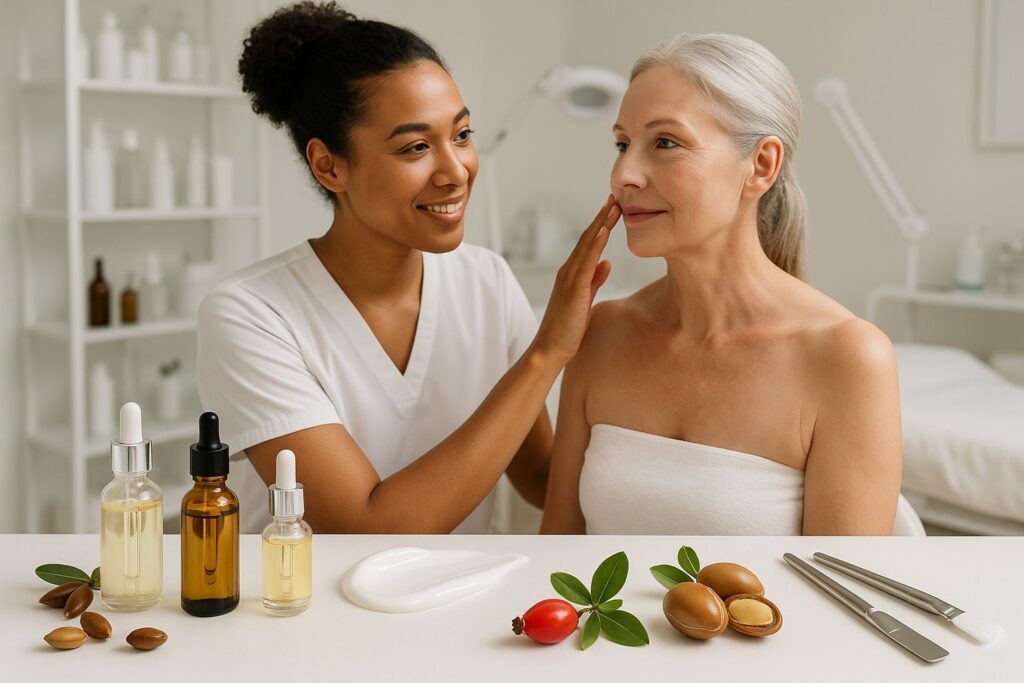
- In the US, “medical-grade skincare” is a common professional term, not a formal FDA product category. It usually refers to evidence-informed formulas used in clinical or professional skin care settings.
- Facial oils can support comfort and barrier function, but they do not replace active ingredients, moisturizers, sunscreen, or professional assessment.
- A compromised skin barrier often affects how well someone tolerates retinoids, acids, and other active products, which is why barrier support matters in treatment planning.
- Oils such as jojoba, rosehip, and argan are often discussed in professional skin care, but the right choice depends on skin type, sensitivity, and congestion tendency.
- For estheticians and aesthetic support professionals, understanding this topic helps with better product literacy, more thoughtful protocols, and clearer communication within scope of practice.
The conversation around skin care has changed. Instead of focusing only on hydration or texture, professional skin care now pays much closer attention to barrier function, product tolerance, ingredient synergy, and long-term skin support.
That shift helps explain why facial oils are being discussed more often alongside active skin care. This is not really a debate between science and nature. In well-designed routines, the more useful question is whether a product supports the skin’s needs without disrupting the overall plan.
Why this topic matters in modern professional skin care
Professional skin care is increasingly shaped by two priorities:
- Ingredient performance
- Barrier support
Those priorities are not in conflict. In fact, they usually work best together.
A routine can include high-interest actives like retinoid-related ingredients, exfoliating acids, or niacinamide, but if the skin becomes irritated, overly dry, or reactive, tolerance often drops. When that happens, even a well-formulated routine may become harder to maintain.
That is where supportive products, including certain facial oils, may have a place. Used thoughtfully, they can complement a broader skin care strategy rather than compete with it.
What medical-grade skincare means in the US
In US skin care marketing and education, the phrase medical-grade skincare is widely used, especially in dermatology practices, med spas, and professional aesthetics. It generally suggests products formulated with a stronger focus on:
- Targeted skin concerns
- Ingredient delivery and performance
- Evidence-informed formulation
- Compatibility with professional treatment plans
An important clarification about the term
In the United States, “medical-grade” is not a formal FDA classification for skin care products. That matters because consumers and even some professionals may assume the term has a specific regulatory definition when it does not.
In practical use, the phrase usually signals that a product is positioned as more performance-oriented than standard cosmetic skin care. That may include formulas built around ingredients such as:
- Niacinamide
- Retinoid-related ingredients
- Alpha hydroxy acids
- Hyaluronic acid
- Ceramides and other barrier-supportive lipids
- Antioxidants
The term can still be useful in professional education, but it should be understood clearly and used carefully.
Why the skin barrier changes the conversation
The skin barrier plays a central role in comfort, hydration balance, and tolerance to active products. When barrier function is impaired, skin may become more reactive and less able to handle even well-known ingredients.
What barrier disruption can look like
Barrier strain does not always appear dramatic. In many cases, it shows up as:
- Tightness or persistent dryness
- Visible redness
- Stinging with products that were previously tolerated
- Increased sensitivity
- A rough or uncomfortable skin feel
- Reduced tolerance to exfoliants or retinoid routines
In professional skin care, this is an important distinction: sometimes the issue is not whether an active ingredient is “good” or “bad,” but whether the skin can comfortably tolerate the overall protocol.
Why tolerance matters as much as potency
A routine does not become more effective simply because it contains stronger or more trend-driven ingredients. If the skin becomes irritated, adherence often declines and product layering becomes less strategic.
This is one reason barrier-supportive products remain relevant in advanced skin care. They can help support the skin environment around an active regimen, which may improve routine consistency and comfort over time.
Where facial oils fit in a professional routine
Facial oils are often misunderstood. They are sometimes treated as either miracle products or as something that should be avoided entirely. In practice, neither extreme is especially helpful.
Some oils may support the skin by contributing emollient benefits and helping reduce transepidermal water loss. That does not make them universally appropriate, but it does explain why they can have a role in certain routines.
How facial oils differ from humectants and moisturizers
A common mistake is assuming all hydrating products do the same thing.
In simple terms:
- Humectants help attract water.
- Emollients help soften and smooth the skin.
- Occlusive ingredients help reduce water loss.
- Facial oils may contribute emollient and, in some cases, supportive barrier-sealing benefits depending on the formula.
That is why a facial oil is not automatically a replacement for a moisturizer. Some oils can be supportive, but they do not cover every function a moisturizer may provide. Likewise, they do not replace active treatment products.
When facial oils may be considered
In a professional context, facial oils may be discussed when the goal is to support:
- Skin comfort
- Visible dryness
- Barrier-conscious routines
- Tolerance around active ingredients
- Mature-looking skin that benefits from added emollient support
They may be less suitable in routines where the skin is highly congestion-prone or where certain textures are poorly tolerated. The specific formula, not just the ingredient label, matters.
Facial oils commonly discussed in professional skin care
Not all oils behave the same way, and not all skin types respond similarly. A thoughtful approach depends on the individual skin picture, the broader routine, and formulation quality.
Jojoba oil
Jojoba oil is frequently discussed because its composition is often described as being similar to skin surface lipids.
In professional skin care conversations, it may be considered for:
- Lightweight emollient support
- Barrier-conscious routines
- Some combination or oilier skin routines, depending on tolerance
Its lightweight feel is one reason it is often mentioned, but tolerance still varies.
Rosehip oil
Rosehip oil is commonly associated with nourishing skin care routines and supportive recovery-focused regimens.
It is often discussed in relation to:
- Dry or depleted-feeling skin
- Mature skin routines
- Supportive care after periods of barrier stress
Its role should be viewed as supportive rather than corrective. It is not a substitute for treatment planning or targeted active ingredients.
Argan oil
Argan oil is often included in conversations around antioxidant-rich and barrier-supportive skin care.
It may be discussed for:
- Dry skin support
- Mature skin routines
- Emollient care when a richer skin feel is desired
As with other oils, suitability depends on the individual, the overall routine, and product formulation.
How active skincare and facial oils may complement each other
The most effective routines are not always the most complicated. Often, the goal is to combine products in a way that respects both skin goals and skin tolerance.
Retinoid-related routines and barrier support
Retinoid-related ingredients are widely used in professional skin care, but they can be associated with dryness, peeling, or sensitivity in some users. In that context, a compatible barrier-supportive product may help improve comfort within the routine.
This does not mean an oil should be added automatically. It means that supportive layering may be worth considering when a routine needs better balance.
Niacinamide and lipid support
Niacinamide is often included in barrier-conscious and tone-focused routines. When paired with a product that supports the skin’s surface comfort, some routines may feel more balanced and easier to tolerate.
For professionals, the key is not the trend of pairing ingredients. It is whether the combination makes sense for the skin’s needs.
Hyaluronic acid and facial oils
Hyaluronic acid and facial oils do different jobs. Hyaluronic acid is usually discussed in relation to hydration support, while oils may help reduce water loss and improve skin feel.
That difference is exactly why they are often seen as complementary rather than interchangeable.
Why integration matters more than choosing sides
One of the least helpful habits in skin care is treating “natural” and “science-based” as opposites.
They are not.
Botanical oils are not automatically better because they are natural. At the same time, high-performance actives do not make supportive ingredients irrelevant. In professional skin care, the strongest approach is usually one that evaluates:
- Formulation quality
- Barrier status
- Tolerance
- Texture compatibility
- Skin goals
- Routine simplicity
The real value is in integration, not ideology.
Common mistakes when combining active skincare and facial oils
This is where many routines become less effective. Not because the products are inherently poor, but because the overall strategy is weak.
Assuming natural means harmless
Even well-known botanical ingredients may not suit every skin type. “Natural” does not guarantee better tolerance or fewer issues.
Replacing treatment products with oils
Facial oils may be supportive, but they do not replace:
- Targeted active ingredients
- Moisturizers in every case
- Sunscreen
- Professional skin assessment
Ignoring congestion tendency
A richer product texture does not work for everyone. Skin that is easily congested may need a different approach than dry or more mature skin.
Adding too many products at once
When several new products are introduced together, it becomes harder to evaluate tolerance and routine compatibility. Simplicity often improves decision-making.
What professionals should look for before adding an oil to a routine
In educational and professional settings, product selection should be based on more than brand positioning or ingredient trends.
Useful considerations include:
- The client or patient’s visible skin behavior and tolerance history
- Whether the routine already includes multiple active products
- The overall texture and finish of the formula
- Fragrance load and potential sensitizing components
- How the product fits with broader barrier-supportive goals
- Whether the routine is becoming overly complex
A thoughtful recommendation is usually less about adding more products and more about improving the logic of the routine.
Why this matters for estheticians and medical aesthetics learners
For estheticians, aesthetic assistants, and professionals in training, this topic matters because skin care recommendations are increasingly tied to treatment outcomes, tolerance, and client education.
Understanding the relationship between active ingredients, barrier support, and facial oils can help with:
- More informed product discussions
- Better protocol awareness
- Stronger client communication
- More realistic expectations around what supportive products can and cannot do
Just as important, professionals should stay aware of scope-of-practice boundaries. In the US, those boundaries vary by state and setting. Educational knowledge is valuable, but recommendations should always align with applicable professional standards and the role of the provider.
Sources and references
- U.S. Food and Drug Administration. Cosmetics and skin care product regulation in the United States.
- American Academy of Dermatology Association. Guidance on moisturizers, skin barrier support, and choosing skin care products.
- Draelos ZD. The science behind skin care: moisturizers. Journal of Cosmetic Dermatology.
FAQS
What does medical-grade skincare actually mean?
In the US, it is a common professional marketing and education term rather than a formal FDA category. It usually refers to skin care positioned around targeted concerns, ingredient performance, and professional use.
Can facial oils be used with active skin care products?
Sometimes, yes. In some routines, they may help support comfort and barrier function. Whether they are appropriate depends on the formula, the skin’s tolerance, and the rest of the routine.
Do facial oils replace moisturizer?
Not necessarily. Oils and moisturizers do not always serve the same role. Some oils may support emollient or barrier-focused care, but they do not automatically replace all moisturizing functions.
Are facial oils a good choice for oily or acne-prone skin?
Not always, but not automatically off-limits either. Suitability depends on the specific oil, the full formula, and how the skin responds. Texture, congestion tendency, and tolerance all matter.
Why is the skin barrier so important in professional skin care?
Barrier function often affects comfort, sensitivity, and how well active ingredients are tolerated. When the barrier is strained, routines may become harder to sustain.
Is a natural oil better than a science-based formula?
Not by default. Natural and science-based products are not opposites. A useful routine is built around skin needs, evidence-informed formulation, and compatibility, not labels alone.
Which facial oil is best for professional skin care?
There is no single best oil for every situation. Jojoba, rosehip, and argan are commonly discussed, but the right choice depends on the skin’s needs and the overall routine design.
Related posts
Regenerative aesthetics in modern aesthetic medicine
Gut-skin axis: how gut health, inflammation, and skin may be connected
Minerals for skin health: hydration, micronutrients, and skin barrier support
Stay Updated
About de author
