
Surgical instruments in medical aesthetics: what they are, how they’re used, and why sterile handling matters
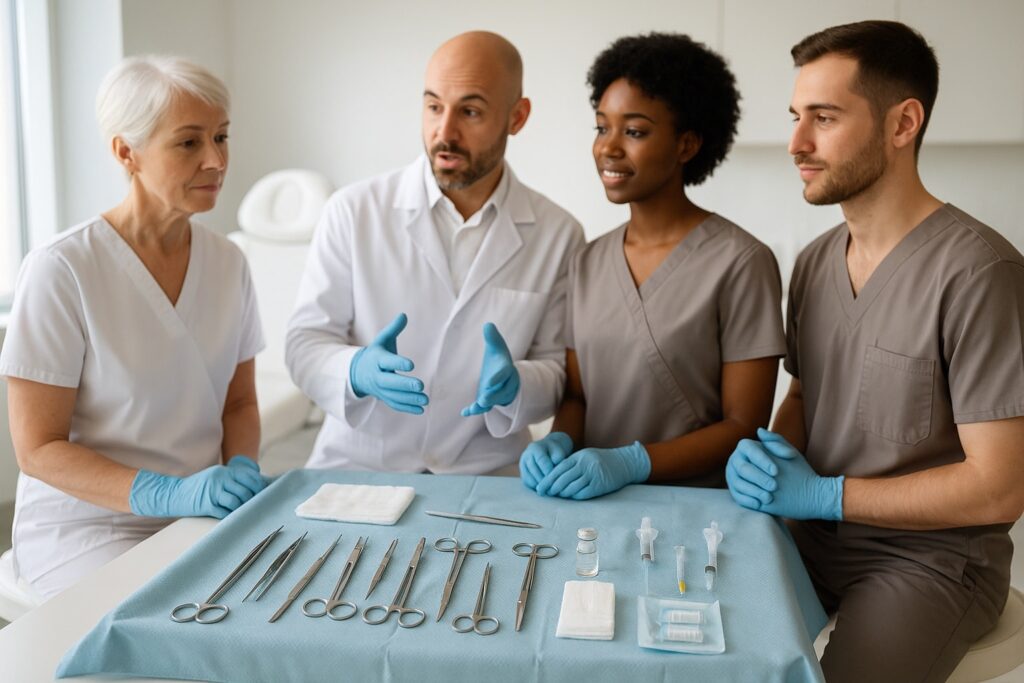
Surgical instruments in medical aesthetics are used to support precision, visibility, tissue handling, closure, and safe workflow during office-based procedures.
- Common categories include cutting tools, forceps, scissors, needle holders, and retraction or exposure instruments, along with separate single-use sterile supplies used in injectable settings.
- The biggest safety considerations are proper instrument selection, clear role boundaries, validated sterilization for reusable items, and strict handling of single-use materials.
- In most medical aesthetic settings, these tools are handled by licensed clinicians, while trained support staff may assist within clinic protocol and state scope-of-practice rules.
- Strong education should cover instrument function, aseptic technique, sterile workflow, and common safety errors, not just memorizing tool names.
What surgical instruments mean in medical aesthetics
In medical aesthetics, the term surgical instruments usually refers to tools that support direct clinical maneuvers in minimally invasive or office-based procedures. These are not necessarily the same instrument sets used in major hospital surgery. In aesthetic settings, instruments are often smaller, more delicate, and selected for controlled work in limited treatment areas.
Depending on the procedure, these instruments may help with:
- making a small, controlled incision
- handling tissue or sterile materials
- improving visibility in a small treatment field
- supporting wound closure when appropriate
- maintaining control and precision throughout the procedure
This topic matters because even relatively minor procedures can involve direct contact with tissue or the sterile field. That makes instrument handling, infection prevention, and workflow discipline essential parts of clinical safety.
Why understanding surgical instruments matters in a medical aesthetics clinic
Instrument knowledge is not just about terminology. In practice, it affects how safely and efficiently a procedure is carried out.
A working understanding of instruments supports:
- better procedural organization
- safer tissue handling
- improved infection control awareness
- more consistent aseptic technique
- clearer communication among the clinical team
In office-based aesthetic care, many safety issues come down to process. The right tool, used the right way, in the right environment, is part of reducing avoidable errors and maintaining professional standards.
Main types of surgical instruments used in medical aesthetics
One of the clearest ways to understand medical aesthetic instruments is by function.
Cutting and dissection instruments
These tools are used when a procedure requires controlled access to tissue or careful separation of tissue layers. In aesthetic medicine, this may involve fine instruments designed for small treatment areas rather than broad surgical exposure.
Examples commonly discussed in education include:
- scalpels
- single-use blades
- surgical scissors used for precise cutting tasks
These instruments require careful handling because their purpose is exact tissue access, not speed or force.
Grasping and holding instruments
Grasping instruments help stabilize tissue, handle materials, or support fine maneuvering during a procedure. Forceps are one of the most commonly referenced examples.
In a medical aesthetics setting, these tools may be used to:
- handle sterile dressings or materials
- support controlled tissue manipulation
- maintain organization within the treatment field
Because these instruments may contact tissue or sterile supplies, proper handling remains a key infection-control issue.
Exposure and retraction instruments
Some procedures require better visibility or access to a small area. Exposure and retraction instruments are used to improve the clinician’s view and maintain control of the treatment field.
In medical aesthetics, the need is usually limited and procedure-specific, but the principle is the same: better visibility can support better precision.
Suturing and closure instruments
When a procedure includes closure, instruments such as needle holders may be used to guide suture placement and support controlled approximation of wound edges.
Educational discussions around these instruments typically focus on:
- recognizing the tool
- understanding its role in closure
- knowing when sterile handling is essential
- understanding that actual use belongs to appropriately trained clinicians
Injection-related sterile supplies and auxiliary tools
This is where many readers need a clear distinction: not everything used during a procedure is a reusable surgical instrument.
In injectable workflows, common items may include:
- syringes
- needles
- cannulas, when applicable
- sterile gauze or drapes
- sharps disposal materials
These are often single-use sterile materials, not reusable surgical instruments. That distinction matters because storage, handling, reprocessing, and disposal requirements are different.
Surgical instruments vs. single-use materials
A common point of confusion in medical aesthetics is the difference between reusable instruments and disposable clinical supplies.
Reusable instruments
Reusable instruments are intended to be cleaned, inspected, and sterilized according to validated protocols before being used again. They need processes that support:
- functional integrity
- proper cleaning
- sterilization validation
- packaging and storage standards
- internal tracking or traceability
Single-use items
Single-use items are designed for one patient encounter and then discarded appropriately. In aesthetic settings, this often includes sharps and various sterile consumables used in injectable or minor office-based procedures.
Reusing a product labeled for single use falls outside appropriate clinical standards and creates avoidable safety concerns.
Where these instruments may be used in aesthetic practice
Instrument use depends on the type of procedure, its invasiveness, and the setting.
Minimally invasive office-based procedures
Some office-based aesthetic procedures may involve small incisions, limited tissue manipulation, or minor closure. In those cases, clinicians may use a combination of cutting, grasping, and closure instruments.
The goal is not complexity. The goal is control.
Injectable procedures
Injectable treatments rely heavily on single-use sterile supplies, but the overall setup may still involve instrument awareness and sterile workflow management.
In these settings, the focus is often on:
- organized tray setup
- maintaining aseptic conditions
- safe sharps handling
- clear separation of sterile and nonsterile items
Procedure support and treatment-room workflow
Even when the procedure itself is limited, the treatment room still needs structure. Instrument organization supports safety by helping reduce confusion, contamination risks, and workflow breakdowns.
This is one reason instrument education matters even for support roles that do not independently perform procedures.
Why sterility and instrument processing are central to safety
Any item that enters the sterile field or comes into direct or indirect contact with tissue must be handled with care. In medical aesthetics, sterilization and aseptic workflow are not optional add-ons. They are basic safety expectations.
Sterile handling protects more than the instrument
Sterility is about the entire process, not just whether a tool looks clean. A safe workflow includes:
- correct storage
- protected transport
- clean preparation areas
- proper setup before use
- avoiding contamination during the procedure
- appropriate handling after the procedure
An instrument can be properly processed and still become unsafe if workflow breaks down during setup or use.
Reprocessing must be validated and consistent
For reusable instruments, cleaning and sterilization should follow established clinical protocols. That includes more than running instruments through a cycle. Staff need to understand inspection, packaging, traceability, and proper separation of clean and contaminated items.
Disposal matters too
Safe practice also includes what happens after use. Sharps disposal, contaminated material handling, and post-procedure instrument segregation are all part of a responsible clinical system.
Who typically handles surgical instruments in a medical aesthetics clinic
In the US, surgical instruments used in aesthetic medicine are generally handled by licensed professionals performing the procedure. Support staff may assist with preparation, organization, and sterilization-related workflows based on their training and the clinic’s internal policies.
That said, role boundaries are not universal.
Scope of practice varies by state
State laws and regulations determine which professionals may perform certain tasks, which require supervision, and which are outside a given role entirely. Because of that, educational content should avoid assuming that every clinic role carries the same authority or responsibility everywhere.
Support roles still need instrument knowledge
Even when support personnel are not performing clinical maneuvers, they may still need to understand:
- instrument identification
- sterile field awareness
- safe handoff practices
- tray organization
- reprocessing workflow
- documentation and traceability expectations
In other words, instrument education is relevant beyond the primary operator.
What quality training on aesthetic instruments should include
A weak training program teaches names. A useful training program teaches judgment.
Instrument recognition and function
Learners should be able to identify common instruments by category and understand the basic purpose of each one within a medical aesthetic setting.
Aseptic technique and workflow awareness
Instrument education should connect directly to sterile handling, treatment-room setup, contamination prevention, and post-procedure processing.
Role boundaries and supervision
Because medical aesthetics involves regulated clinical activity, education should clearly separate what learners need to understand from what they are legally authorized to do.
Common safety mistakes to avoid
Without giving procedural instruction, it is still helpful to teach common risk areas, such as:
- confusing reusable instruments with disposable supplies
- breaking sterile workflow during setup
- mishandling sharps
- failing to separate clean and contaminated items
- overlooking documentation and traceability processes
What professionals and learners should look for in educational content
If you are evaluating training on surgical instruments in medical aesthetics, look for content that is practical, clear, and safety-centered.
Strong educational content should:
- explain instrument categories in plain language
- connect tools to real clinical workflow
- emphasize sterilization and aseptic handling
- clarify the difference between observation, support, and performance
- reflect US practice expectations without overstating scope
- avoid turning education into an unsafely detailed procedure manual
That balance matters. The goal is informed learning, not overconfidence.
Learn the safety foundations behind aesthetic procedures
If you want to build stronger clinical awareness in medical aesthetics, focus on education that connects instruments, sterile workflow, and professional role boundaries in a practical way. Eduasthetics offers learning designed to help students and professionals understand the standards that support safer aesthetic practice.
Sources and references
- Centers for Disease Control and Prevention. Guideline for disinfection and sterilization in healthcare facilities.
- Occupational Safety and Health Administration. Bloodborne Pathogens Standard.
- Association of periOperative Registered Nurses. Guidance on sterile technique and instrument processing.
FAQS
What surgical instruments are commonly used in medical aesthetics?
Common categories include scalpels or blades, forceps, scissors, needle holders, and exposure or retraction tools used in select office-based procedures. Injectable workflows also involve single-use sterile supplies such as syringes and needles, which should be distinguished from reusable instruments.
Are these the same instruments used in major surgery?
Not always. Medical aesthetics often uses smaller, more specialized instruments designed for precision in limited treatment areas rather than broad surgical exposure.
Why is sterilization so important in aesthetic clinics?
Because instruments and supplies may contact tissue, sterile materials, or the treatment field. Proper cleaning, sterilization, storage, and aseptic handling help support infection prevention and safe workflow.
Who is allowed to handle surgical instruments in a medical aesthetics setting?
That depends on the task, the professional role, the clinic’s protocols, and state law. In general, licensed clinicians perform procedures, while trained support personnel may assist within permitted boundaries.
What is the difference between a reusable instrument and a single-use item?
Reusable instruments are designed to be cleaned and sterilized according to validated protocols. Single-use items are intended for one-time use and must be discarded appropriately after the procedure.
Is instrument handling covered in medical aesthetics education?
Yes. In quality education, instrument handling is usually taught as part of broader clinical awareness, sterile workflow, safety principles, and procedural support training.
Related posts
Infection control in medical aesthetic clinics: essential safety protocols for estheticians and assistants
How to build a resume for medical aesthetic assistant jobs in the U.S.
How to handle difficult patients in a medical aesthetics clinic
Stay Updated
About de author
