
Biostimulation vs mesotherapy: how to understand the difference and when each may fit the patient profile
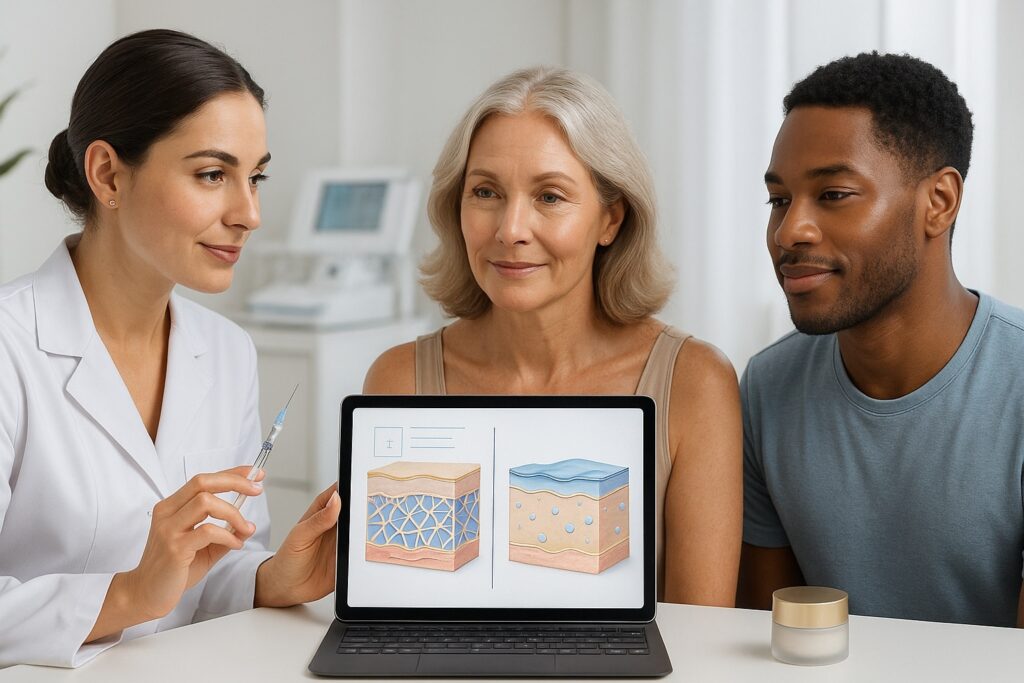
- Biostimulation and mesotherapy are not interchangeable terms. In aesthetic medicine, they are usually discussed as different treatment categories with different goals.
- Biostimulation is typically associated with collagen-support and longer-term skin quality planning, while mesotherapy is more often linked to hydration, revitalization, and localized skin-quality concerns.
- The right conversation depends on the patient profile, treatment goals, anatomy, and overall plan, not on a simple “which is better” comparison.
- Many real-world treatment plans involve other categories too, including fillers, neuromodulators, PRP, and energy-based treatments.
- For aesthetic professionals and support staff, understanding the language behind these categories helps with patient communication, workflow, and safer treatment planning discussions.
Biostimulation vs mesotherapy is a common comparison in aesthetic medicine, but the two terms are often oversimplified online. In practice, they usually refer to different treatment concepts, different goals, and different planning logic.
That distinction matters. It matters for professionals learning the field, for support staff working in aesthetic settings, and for anyone trying to understand how skin quality treatments are discussed in a clinical environment.
A clearer way to approach the topic is not to ask which one is “better.” A more useful question is: what is each category generally used to address, and when might one be more relevant than the other based on the patient profile?
Why this comparison matters in aesthetic medicine
Skin quality is one of the biggest focus areas in modern aesthetics. Patients may present with concerns such as dehydration, dullness, loss of elasticity, early textural change, or more advanced signs of aging. Those concerns can sound similar on the surface, but they do not always point to the same treatment category.
That is why biostimulation vs mesotherapy is more than a terminology issue. The language used in consultation and treatment planning shapes expectations, influences how options are presented, and affects how combination treatments are discussed.
For educators and aesthetic professionals, understanding this difference also helps avoid a common mistake: treating all injectable skin-quality treatments as if they belong to the same group.
What biostimulation usually means
In aesthetic medicine, biostimulation is generally used to describe treatment approaches discussed in relation to supporting biologic activity associated with tissue quality and collagen-related responses.
The exact meaning can vary by product, platform, and provider preference, but biostimulation is commonly associated with:
- Collagen-support discussions
- Skin firmness and structural quality conversations
- Longer-term skin quality planning
- Regenerative-oriented aesthetic strategies
- Healthy aging treatment frameworks
This does not mean every treatment described as biostimulatory works in the same way, and it does not mean outcomes are identical across products or patients. It simply means the category is usually discussed with a broader tissue-support goal in mind.
Treatment categories often discussed as biostimulatory
In the US aesthetic market, biostimulation conversations may include:
- Injectable biostimulators, such as categories involving poly-L-lactic acid or calcium hydroxylapatite
- Collagen-stimulation-focused treatment planning related to skin quality and firmness
- Energy-based treatment discussions, including radiofrequency, ultrasound, laser-based rejuvenation, or microneedling in some contexts
These categories are not interchangeable, but they may appear in the same conversation when the goal is improved skin quality over time rather than immediate volumization or surface hydration alone.
What makes biostimulation different from filler-focused discussions
One of the biggest areas of confusion is the assumption that biostimulators are simply another kind of filler. In professional discussions, they are often treated differently.
Traditional hyaluronic acid fillers are usually discussed around:
- Volume
- contour
- facial support
- shape refinement
Biostimulatory approaches are more often discussed around:
- tissue quality
- collagen-support concepts
- skin firmness
- gradual improvement frameworks
There can be overlap in broader treatment planning, but the treatment intent is not usually the same.
What mesotherapy usually means
Mesotherapy is generally used to describe localized treatment approaches used in some aesthetic settings for skin revitalization, hydration-focused planning, and other targeted concerns.
The term can cover a wide range of formulations and approaches depending on the market and clinical setting, which is one reason it can become confusing. In some conversations, mesotherapy overlaps with terms such as skin boosters or biorevitalization, although these are not always exact synonyms.
In general, mesotherapy is more commonly associated with:
- Hydration-focused treatment discussions
- Skin revitalization
- Superficial skin-quality concerns
- Scalp-related aesthetic conversations in some settings
- Certain body-focused treatment discussions
Categories commonly discussed under mesotherapy
Mesotherapy-related conversations may involve:
- Skin boosters, often discussed in relation to hydration and glow-oriented goals
- Biorevitalization concepts, commonly linked to skin freshness and revitalization
- Scalp and hair-support discussions in some aesthetic settings
- Body-focused mesotherapy in selected markets and use cases
Because terminology is not standardized across every clinic, training program, or region, it is important not to assume that every product or protocol labeled “mesotherapy” refers to the same thing.
Biostimulation vs mesotherapy: the practical difference
If a patient or learner asks for the simplest explanation of biostimulation vs mesotherapy, this is the most useful distinction:
- Biostimulation is more often discussed around collagen-support, tissue response, and longer-term skin quality planning
- Mesotherapy is more often discussed around hydration, revitalization, and localized skin-quality support
That said, real-world treatment planning is rarely that neat. Some cases sit in the middle, and some providers use these categories as part of a broader combination strategy rather than as isolated choices.
Biostimulation discussions often center on
- Skin firmness and elasticity concerns
- Collagen-support goals
- Longer-range treatment plans
- Broader facial or tissue quality strategies
- Healthy aging approaches
Mesotherapy discussions often center on
- Dehydrated or tired-looking skin
- Dullness and surface-level skin quality concerns
- Preventive aesthetic planning
- Refresh-focused treatment conversations
- Complementary skin-quality support
This is why the question is usually not “which one is better?” The more relevant question is which treatment category aligns more closely with the treatment objective and the patient profile being evaluated.
How the patient profile can shape the conversation
A patient profile is not just age. In aesthetic medicine, it usually includes a broader set of factors such as:
- Primary concern
- Skin quality pattern
- treatment history
- anatomy
- degree of visible aging
- overall goals
- tolerance for maintenance
- interest in immediate vs gradual change
- lifestyle and expectation level
These factors help guide which category may be discussed first.
When biostimulation may be the more relevant discussion
Biostimulation may be part of the conversation when the overall goal relates more to longer-term tissue quality than to quick hydration or surface revitalization.
Examples of concerns that may lead to this type of discussion include:
- Reduced firmness
- visible textural aging
- loss of skin support quality
- broader healthy aging planning
- desire for a treatment strategy that focuses on gradual skin quality improvement
This does not mean the patient is automatically a candidate for any specific treatment. It means the treatment conversation may move toward collagen-support or tissue-oriented approaches rather than purely hydration-focused ones.
When mesotherapy may be the more relevant discussion
Mesotherapy may enter the conversation when the concern appears more aligned with hydration, radiance, localized revitalization, or maintenance-oriented skin quality support.
Examples may include:
- skin that appears dull or tired
- dehydration-focused concerns
- early skin-quality changes without a strong need for structural support
- maintenance-focused care plans
- complementary treatment planning around skin appearance
In these cases, a provider may discuss mesotherapy-related options as part of a more superficial or supportive skin-quality strategy.
Why “patient profile” should never be reduced to one feature
A common oversimplification is to match treatment category to age alone, such as saying younger patients get mesotherapy and older patients get biostimulation. That is not a reliable framework.
A younger patient may have concerns that lead to a collagen-support discussion, while an older patient may benefit from hydration-focused planning as part of a larger care plan. The better approach is always to consider the whole profile, not a single trait.
Where skin boosters, PRP, fillers, and energy-based treatments fit
One reason this topic gets confusing is that biostimulation and mesotherapy rarely exist in isolation. In real aesthetic practice, they are discussed alongside several other treatment categories.
Skin boosters and biorevitalization
These terms often show up near mesotherapy discussions because they are commonly associated with:
- hydration
- skin freshness
- glow
- skin-quality support
Depending on how a clinic or educator uses the terminology, skin boosters may be described as part of mesotherapy, adjacent to mesotherapy, or as a separate skin-quality category.
PRP and regenerative-oriented discussions
PRP is often mentioned in conversations about:
- skin quality
- scalp-related treatment planning
- combination care strategies
- regenerative-oriented approaches
It is not automatically interchangeable with mesotherapy or biostimulation, but it frequently appears in the same educational space.
Hyaluronic acid fillers
Fillers are typically discussed separately because they are usually linked to:
- restoring volume
- contour support
- facial shaping
- structural correction
That makes them conceptually different from hydration-focused mesotherapy and from collagen-support biostimulation, even though combination planning is common.
Energy-based treatments
Radiofrequency, ultrasound-based treatments, laser procedures, and microneedling may also be part of skin quality treatment planning. In some cases, these are discussed alongside biostimulatory concepts because they are associated with tissue response and skin remodeling conversations.
The key takeaway is simple: biostimulation vs mesotherapy is only one part of a much larger treatment-planning landscape.
Why combination treatment planning is so common
Many patients do not fit neatly into one category. A patient may have dehydration, textural change, early laxity, and volume loss at the same time. That is why combination planning is common in aesthetic medicine.
Professional discussions may involve combinations such as:
- a biostimulatory approach with filler planning
- mesotherapy-related care with microneedling
- scalp-focused mesotherapy discussions alongside PRP
- skin-quality planning combined with energy-based treatments
Combination planning should not be understood as stacking treatments for the sake of doing more. In a well-run clinical environment, it reflects a rationale tied to goals, timing, appropriateness, and professional judgment.
Common mistakes when comparing biostimulation and mesotherapy
Poor online content tends to frame this topic in overly simplistic terms. These are some of the most common misunderstandings.
Treating the terms as exact opposites
They are different categories, but not perfect opposites. There can be overlap in skin-quality goals, and terminology can vary across providers and markets.
Assuming one category is always stronger or better
A treatment category is not inherently better in the abstract. Relevance depends on the concern being addressed, the broader plan, and the provider’s clinical judgment.
Confusing hydration with structural support
Hydration-focused care and collagen-support planning do not serve exactly the same purpose. A patient may need one, the other, or a broader strategy that considers both.
Ignoring the role of combination treatment planning
Real-world aesthetics often involves layered planning rather than one standalone category.
Safety, scope of practice, and realistic expectations
Because this topic sits within medical aesthetics, it should be handled carefully.
A few principles matter:
- Treatment categories are not universal solutions
- No treatment should be framed as guaranteed or permanent
- Product selection and treatment approach depend on professional evaluation
- Scope of practice varies across US states
- Injectable procedures and treatment responsibilities may be limited to specific licensed professionals or require medical oversight, depending on applicable law and setting
For support staff, estheticians, and newer professionals, understanding these boundaries is part of responsible education. Knowing how treatments are discussed is valuable. Performing, delegating, or recommending them outside one’s legal role is a separate issue and must align with state law, employer policy, and clinical supervision requirements.
Why this topic matters for aesthetic education
For learners in medical aesthetics, this comparison is valuable because it improves more than vocabulary. It strengthens foundational treatment literacy.
A solid understanding of biostimulation vs mesotherapy can help with:
- clearer patient communication
- better chart and workflow comprehension
- more accurate treatment category recognition
- stronger support in consultation settings
- better understanding of how skin-quality plans are built
That is especially relevant in educational environments where students need to understand not only what treatments are called, but how they are positioned within broader aesthetic care planning.
Learn the language behind modern aesthetic treatment planning
Understanding how biostimulation, mesotherapy, fillers, PRP, and other categories are discussed can help you build stronger treatment literacy and communicate more confidently in aesthetic settings. Eduasthetics offers educational content designed to help professionals and learners navigate the field with more clarity and context.
Sources and references
- American Society for Dermatologic Surgery. Cosmetic injectable and skin rejuvenation resources.
- American Academy of Dermatology Association. Guidance on cosmetic procedures and skin aging.
- Journal of Clinical and Aesthetic Dermatology. Review literature on biostimulators, skin quality treatments, and aesthetic rejuvenation.
FAQS
What is the main difference between biostimulation and mesotherapy?
Biostimulation is usually discussed in relation to collagen-support and longer-term tissue quality, while mesotherapy is more often associated with hydration, revitalization, and localized skin-quality support.
Are skin boosters the same as mesotherapy?
Not always. In some settings, skin boosters are discussed as part of mesotherapy-related care, while in others they are treated as a separate but closely related skin-quality category.
Are biostimulators the same as dermal fillers?
They are often discussed differently. Fillers are typically associated with volume and contour, while biostimulatory treatments are more commonly linked to collagen-support and gradual skin quality improvement.
Can biostimulation and mesotherapy be combined?
They may be part of combination planning in some clinical settings. Whether that makes sense depends on the treatment goal, patient profile, and provider judgment.
Which category is more commonly discussed for hydration?
Mesotherapy-related treatments are more often associated with hydration-focused planning, especially in discussions around skin revitalization and superficial skin-quality support.
Which category is more commonly discussed for collagen support?
Biostimulation is more commonly associated with collagen-support and tissue-oriented treatment planning.
Do estheticians perform these treatments in the United States?
Rules vary by state and by treatment type. Many injectable procedures fall under medical practice rules or require specific licensure and oversight. Professionals should always verify the laws and regulations that apply in their state and clinical setting.
Related posts
Needle-free biostimulation in medical aesthetics: what professionals should know
Skincare ingredients that should not be combined in aesthetic practice
Ultrasound in aesthetics: uses, types, and when it may be considered
Stay Updated
About de author
