
Ultrasound in aesthetics: uses, types, and when it may be considered
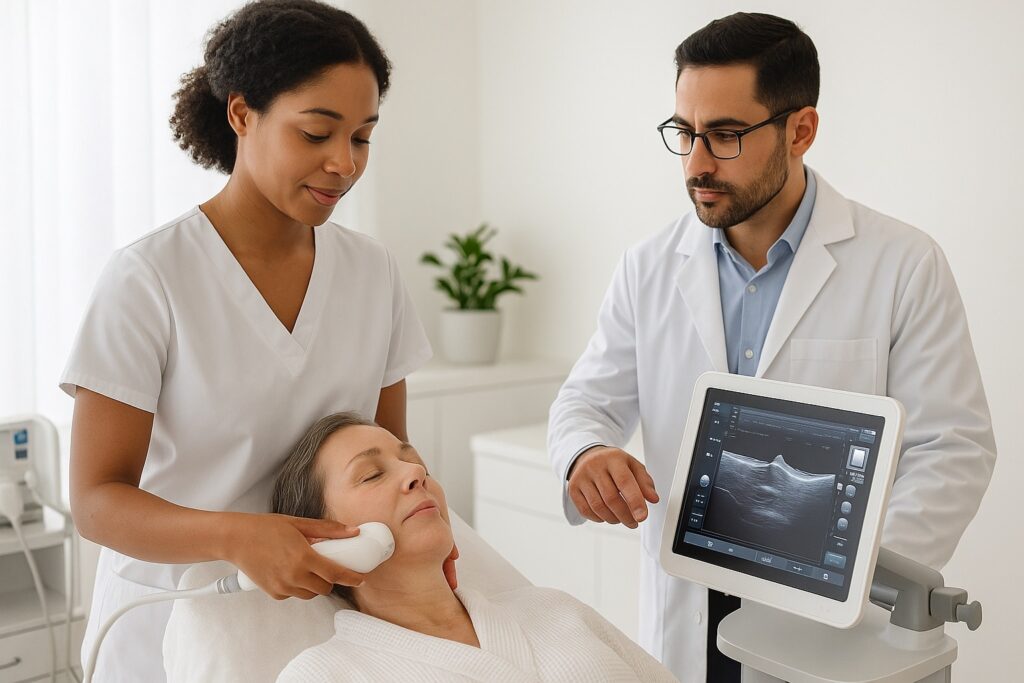
- In aesthetics, “ultrasound” can refer to different technologies, including therapeutic ultrasound for tissue-focused treatments and ultrasound imaging for assessment and planning.
- High-intensity focused ultrasound and microfocused ultrasound are often discussed for non-surgical skin tightening and support-related concerns, especially in the lower face, jawline, neck, and brow area.
- Ultrasound-based treatments are not the same as radiofrequency, weight-loss treatments, or surgery, and they are not interchangeable across devices.
- Results are typically described as gradual rather than dramatic, which makes patient selection, treatment goals, and realistic expectations especially important.
- For professionals, safe use depends on training, device knowledge, case selection, and compliance with state scope-of-practice rules.
When people search for ultrasound in aesthetics, they are often looking for a simple answer: what it does, where it is used, and whether it is the same as HIFU, microfocused ultrasound, or even ultrasound imaging. The challenge is that the term “ultrasound” is often used broadly online, even though it may refer to very different technologies and treatment goals.
In US aesthetic practice, ultrasound-based technologies are commonly discussed in relation to non-surgical skin tightening, tissue support, and treatment planning in medical aesthetic settings. They may also appear in conversations about facial rejuvenation, body-focused protocols, and combination treatment plans. But not every ultrasound device serves the same purpose, and not every concern is best addressed with ultrasound.
Understanding those differences matters for both patients researching options and professionals building a stronger foundation in aesthetic education.
What ultrasound means in aesthetics
In medical aesthetics, ultrasound may refer to two broad categories:
- Therapeutic ultrasound technologies, which are used as part of aesthetic treatment discussions
- Ultrasound imaging, which is used in some advanced settings to support anatomical assessment and planning
These are not the same.
Therapeutic ultrasound is generally discussed as an energy-based treatment category. Depending on the device, it may be associated with skin tightening, tissue support, and non-surgical lifting conversations. Ultrasound imaging, by contrast, is not a rejuvenation treatment. It is a visualization tool used in some practices to better understand anatomy and support decision-making.
That distinction is important because many online articles blur the lines between treatment devices and imaging tools.
The main types of ultrasound discussed in aesthetic medicine
High-intensity focused ultrasound
High-intensity focused ultrasound, often called HIFU, is one of the most recognized ultrasound-based treatment categories in aesthetic medicine.
In professional discussions, HIFU may be considered for:
- Mild to moderate skin laxity
- Non-surgical lifting conversations
- Lower face and jawline concerns
- Submental area concerns
- Patients interested in procedures with little to no downtime discussion
HIFU is often presented as an option for people exploring non-surgical approaches, but that does not mean it is appropriate for every concern. The quality of the result discussion depends heavily on the device, the treatment plan, and the individual case.
Microfocused ultrasound
Microfocused ultrasound, sometimes referenced as MFU or MFU-V depending on the technology, is also widely discussed in US practice.
It is commonly associated with conversations around:
- Skin tightening
- Tissue support
- Brow area lifting in selected cases
- Lower face support
- Neck and jawline treatment planning
In many educational and clinical settings, microfocused ultrasound is framed as a more specific category than the broader term “ultrasound treatment.” That is one reason professionals should be careful not to use all ultrasound terms as if they mean the same thing.
Ultrasound imaging in advanced aesthetic settings
Ultrasound imaging is increasingly relevant in advanced aesthetic settings, especially where anatomy and treatment planning are priorities.
It may be discussed in relation to:
- Anatomical assessment
- Procedure planning
- Supportive visualization before or during certain aesthetic decisions by qualified licensed professionals
This is distinct from therapeutic ultrasound. Imaging helps assess; therapeutic ultrasound is used as part of a treatment strategy.
HIFU vs microfocused ultrasound: why the difference matters
One of the most common search questions is whether HIFU and microfocused ultrasound are the same. In casual online conversation, they are sometimes used loosely. In professional settings, that can be misleading.
They are related, but not always interchangeable
Depending on the device and manufacturer, differences may involve:
- Device design
- Energy delivery pattern
- Treatment depth
- Tissue target
- Planning rationale
- Clinical goals being discussed
That means a provider or trainee should avoid assuming that all ultrasound-based treatments produce the same effect or are suitable for the same patient profile.
The treatment goal shapes the conversation
In practice, one technology may be discussed more often in relation to lifting-oriented concerns, while another may be discussed in terms of support, firmness, or tissue-focused planning. The right discussion depends on the device being used and the concern being evaluated.
This is also why online before-and-after claims should be interpreted carefully. The term “ultrasound” alone does not tell you enough about the device, indication, or expected outcome.
What ultrasound is used for in facial aesthetics
Facial aesthetics is where ultrasound-based treatments are most commonly discussed. Depending on the device and the case, ultrasound may be part of conversations around gradual tightening, support, and mild to moderate laxity.
Common facial areas often discussed
Professional treatment discussions often involve areas such as:
- Brow area
- Lower face
- Jawline
- Neck
- Submental area
These areas are commonly mentioned because they are associated with visible structural change over time, especially as skin support changes with aging.
What types of concerns may lead to ultrasound discussions
Ultrasound-based treatments may come up when someone is exploring:
- Early or moderate skin laxity
- Interest in non-surgical options
- Maintenance-oriented aesthetic planning
- Gradual improvement rather than a dramatic change
- Combination treatment planning across multiple concerns
The keyword here is discussion, not automatic indication. A concern being common does not mean ultrasound is the right choice for it.
Is ultrasound used for body contouring or body treatments?
Yes, some ultrasound-based devices are discussed in body-focused aesthetic treatments, but this area often causes confusion.
Ultrasound for body aesthetics is not the same as weight loss
Some devices may be part of conversations about:
- Non-invasive body contouring
- Body-focused aesthetic planning
- Skin laxity in selected contexts
However, these treatments should not be confused with weight-loss interventions. Aesthetic body treatments may be discussed as part of contouring or appearance-related goals, not as a substitute for medical weight management or surgery.
Body treatment discussions depend heavily on the device
Not all ultrasound technologies used on the face are used in the same way on the body. Device category, indication, and treatment rationale can differ substantially. That is why professionals should be cautious about generalizing across platforms.
Ultrasound vs radiofrequency in aesthetics
Another common question is how ultrasound compares with radiofrequency. They are often grouped together because both are energy-based treatment categories, but they are not the same.
The mechanism of action is different
In broad terms, ultrasound and radiofrequency differ in:
- How energy is delivered
- Which tissue layers are being targeted
- The treatment rationale behind device selection
- How they fit into broader aesthetic planning
Because of these differences, a provider may discuss one over the other depending on the patient’s concerns, anatomy, treatment history, and desired level of intervention.
They may be used separately or as part of a broader plan
In some aesthetic practices, ultrasound and radiofrequency are presented as distinct options. In others, they may both be part of a combination treatment strategy. The important point is that these technologies are not interchangeable just because they are both device-based.
When ultrasound-based treatments may be considered
Ultrasound-based treatments are often discussed in cases where the goals are conservative, non-surgical, and gradual.
Situations where ultrasound may enter the conversation
A qualified professional may discuss ultrasound-based technologies when there is interest in:
- Mild to moderate laxity
- Skin support and firmness
- Maintenance between other aesthetic treatments
- Non-surgical facial rejuvenation
- Multi-modality treatment planning
For many people, the appeal is the possibility of a device-based treatment that fits a lower-downtime aesthetic plan.
When ultrasound may not be the main option
Ultrasound may be less central to the discussion when concerns involve:
- Significant structural correction
- Advanced laxity
- Volume loss better addressed through other categories
- Goals that are unrealistic for a non-surgical device
This is one of the most important educational points: not every aesthetic concern is best addressed with tightening-focused technology. In some cases, volume, structure, texture, or surgical referral may be more relevant topics.
What kind of results are usually discussed
One of the most helpful ways to set expectations around ultrasound in aesthetics is to emphasize that results are usually described as progressive.
Changes are often gradual
Treatment discussions may involve gradual changes related to:
- Perceived firmness
- Skin appearance
- Support-related concerns
- Overall rejuvenation planning
This gradual profile is one reason ultrasound-based treatments are often part of longer-term aesthetic strategies rather than one-time “transformation” expectations.
Results are not guaranteed
Outcomes can vary based on:
- Device selection
- Individual anatomy
- Baseline laxity
- Treatment goals
- Whether the treatment is used alone or in combination with other approaches
Credible aesthetic education should always avoid promising dramatic or permanent results.
How many sessions are usually involved
There is no universal answer to the session question, even though it is one of the most common searches.
Planning may vary depending on:
- The technology used
- The treatment area
- The concern being addressed
- The person’s response over time
- Whether the approach is standalone or part of a larger plan
That means session count should be discussed as part of individualized treatment planning rather than as a one-size-fits-all expectation.
Safety and professional considerations
Because this is a YMYL-adjacent topic, safety should not be treated as a footnote. Ultrasound-based aesthetic treatments depend on more than device availability.
What influences safe use
Safer and more appropriate use depends on factors such as:
- Device selection
- Treatment planning
- Proper settings according to device protocols
- Professional technique
- Contraindication awareness
- Appropriate case selection
Even when a treatment is widely discussed, that does not mean it is suitable for every patient or every practice environment.
Scope of practice matters in the United States
In the US, who can perform or assist with aesthetic treatments may vary based on state law, licensing rules, supervision requirements, and practice setting. That means education should include not only device familiarity, but also an understanding of professional boundaries and legal context.
Why training matters for aesthetic professionals
For estheticians, medical aesthetic assistants, and other professionals working in or around medical aesthetics, ultrasound is not just a device topic. It is a treatment-planning and safety topic.
Strong training goes beyond operating the machine
A useful educational foundation may include:
- Basic device categories and terminology
- Differences between HIFU, microfocused ultrasound, and imaging
- Treatment rationale
- Contraindications and safety awareness
- Realistic expectation setting
- Role clarity within the practice
- Documentation and workflow awareness
This kind of knowledge helps professionals communicate more clearly, support better patient education, and function more effectively in medical aesthetic clinics and med spas.
Better education supports better decision-making
Even for non-prescribing professionals, understanding how ultrasound-based technologies are discussed in practice can improve:
- Case communication
- Treatment coordination
- Patient experience
- Recognition of limitations
- Appropriate referral conversations within the care team
That makes education especially valuable in a field where technologies evolve quickly and terminology is often used inconsistently online.
Sources and references
- American Academy of Dermatology Association. Nonsurgical skin tightening and rejuvenation guidance.
- American Society for Dermatologic Surgery Association. Energy-based device and skin tightening resources.
- Journal of Clinical and Aesthetic Dermatology. Research on microfocused ultrasound and energy-based aesthetic treatments.
FAQS
What is ultrasound used for in aesthetics?
Ultrasound in aesthetics is commonly discussed for non-surgical skin tightening, tissue support, and selected facial or body-focused treatment plans. It may also refer to ultrasound imaging used for assessment in advanced settings.
Is HIFU the same as microfocused ultrasound?
Not always. The terms are sometimes used loosely online, but in professional settings they may differ by device design, treatment depth, energy delivery, and clinical purpose.
Can ultrasound help with skin laxity?
Ultrasound-based treatments are often discussed in cases of mild to moderate laxity, especially when someone is interested in non-surgical options. Whether it is appropriate depends on professional evaluation and treatment goals.
Is ultrasound in aesthetics the same as radiofrequency?
No. Both are energy-based treatment categories, but they work differently and may be used for different tissue targets and treatment strategies.
Is ultrasound used on the face or the body?
Both may be discussed, depending on the device. Facial conversations often focus on the brow, jawline, lower face, neck, and submental area, while some devices are also discussed in body contouring or body-focused aesthetic protocols.
How quickly do results appear?
Results are often described as gradual rather than immediate. Timelines can vary by device, treatment approach, and individual response.
How many ultrasound sessions are needed?
There is no standard number for everyone. Session planning depends on the technology, treatment area, aesthetic goals, and whether ultrasound is used alone or as part of a broader plan.
Do aesthetic professionals need training to work with ultrasound-based technologies?
Yes. Meaningful training should cover device basics, treatment rationale, safety principles, contraindications, and scope-of-practice awareness, not just machine operation.
Related posts
Needle-free biostimulation in medical aesthetics: what professionals should know
Skincare ingredients that should not be combined in aesthetic practice
Mesotherapy in aesthetic medicine: what it means for facial, hair, and body treatments
Stay Updated
About de author
