
Mesotherapy in aesthetic medicine: what it means for facial, hair, and body treatments
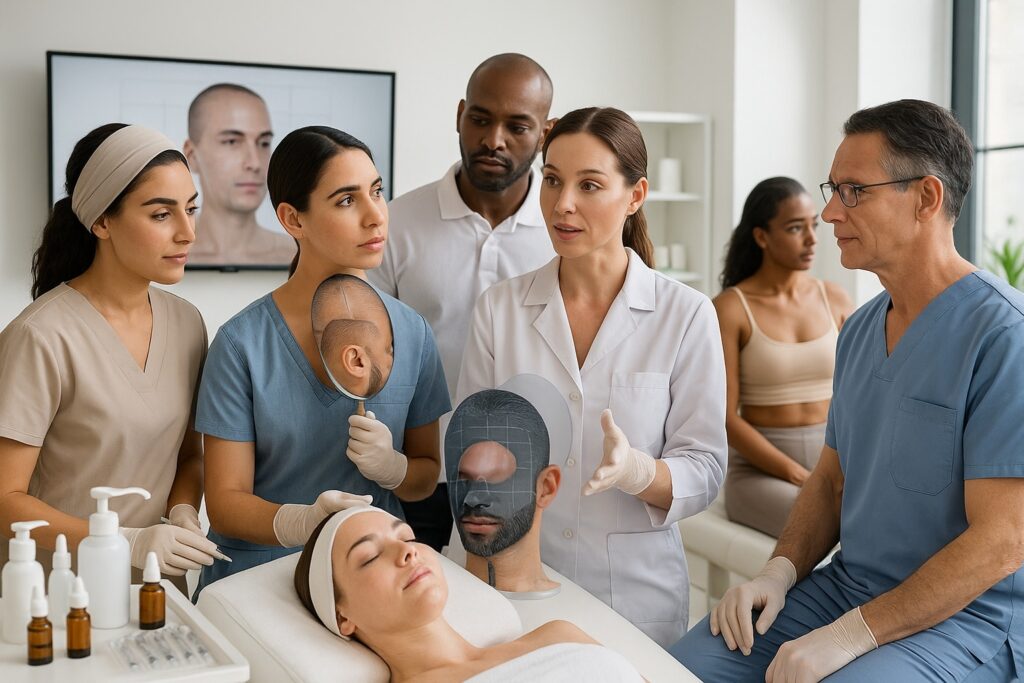
- Mesotherapy is not one standardized treatment. In U.S. aesthetic practice, the term may refer to different localized treatment approaches depending on the area treated, the product used, and the professional setting.
- It is commonly discussed in relation to facial skin quality, scalp and hair-support conversations, and body-focused aesthetic planning, but the treatment rationale and terminology can vary widely.
- Mesotherapy is often considered alongside other modalities such as microneedling, PRP, radiofrequency, and skin-rejuvenation protocols rather than as a standalone solution for every concern.
- Outcomes, treatment frequency, and suitability depend on the individual case, product category, professional assessment, and applicable state scope-of-practice rules.
- For professionals and learners, understanding mesotherapy requires more than knowing the term. Training in treatment categories, contraindications, safety principles, and clinical judgment is essential.
Mesotherapy remains a widely discussed topic in aesthetic medicine, but it is also one of the most misunderstood. In the United States, the term can mean different things depending on the treatment area, product category, provider background, and regulatory context.
That variability matters. Mesotherapy is better understood as a broad treatment concept rather than a single uniform procedure. It may come up in conversations about facial skin quality, hydration-focused protocols, scalp-related aesthetic planning, and certain body concerns. For that reason, anyone researching mesotherapy should look beyond the label and focus on how the treatment is being defined in a specific clinical setting.
What mesotherapy means in U.S. aesthetic medicine
In aesthetic medicine, mesotherapy generally refers to localized treatment approaches used within broader aesthetic plans. The exact meaning can shift from one practice to another. Some professionals use the term broadly for injectable skin-support protocols, while others reserve it for more specific treatment concepts.
Why the term can be confusing
A major reason mesotherapy causes confusion is that it is not always used consistently. In practice, the same word may be associated with:
- Facial skin-quality treatments
- Hydration-focused injectable discussions
- Scalp and hair-support protocols
- Body contouring or cellulite-related conversations
- Combination treatment planning
This is why mesotherapy should not be treated as a fixed category with one universal technique, one standard product, or one predictable outcome.
What mesotherapy is not
Mesotherapy is often overgeneralized online. A more accurate view is that it is not:
- A catch-all replacement for other aesthetic treatments
- The same thing as dermal filler treatment
- A guaranteed way to achieve dramatic or permanent changes
- A weight-loss treatment
- A universal option for every patient or every aesthetic concern
For professionals, this distinction is important because patient expectations can easily become misaligned when terminology is vague.
How facial mesotherapy is typically discussed
Facial mesotherapy is most often discussed in relation to skin quality rather than structural volumizing. In aesthetic settings, these conversations usually focus on overall skin appearance, hydration, texture, and support for age-related skin changes.
Skin quality and hydration-focused discussions
Many facial mesotherapy conversations center on concerns such as:
- Dull-looking skin
- Skin that appears dehydrated
- Uneven texture
- Early visible changes associated with aging
- Interest in non-surgical skin-rejuvenation options
These goals are different from those associated with classic filler treatments, which are typically discussed more in relation to volume, contour, and structural support.
Skin boosters and mesotherapy: where they overlap and where they differ
One of the most common questions in this area is whether skin boosters and mesotherapy are the same. The answer is not always straightforward.
In some practices, skin boosters may be discussed under the broader mesotherapy umbrella because both can be associated with hydration-focused injectable approaches and skin-quality treatment planning. In other settings, skin boosters are treated as a separate category.
The key point is that terminology varies. When professionals discuss these options, the more important issue is not the label itself but the treatment objective, product category, and expected role within a broader aesthetic plan.
Hyaluronic acid and biorevitalization concepts
Some facial mesotherapy discussions also involve hyaluronic acid-based hydration concepts or biorevitalization terminology. These are often positioned around skin support rather than facial reshaping.
Again, definitions are not always standardized. For learners and new aesthetic professionals, this is a good reminder that aesthetic terminology often reflects practice style as much as scientific classification. Strong training helps clarify these differences and reduces confusion in patient communication.
Mesotherapy for hair and scalp-related discussions
Mesotherapy is also frequently mentioned in relation to scalp-focused aesthetic planning and hair-support conversations. This area tends to attract strong consumer interest, especially from people searching for non-surgical options related to hair appearance.
How it may fit into scalp treatment planning
In professional settings, hair-related mesotherapy may be discussed alongside broader scalp protocols that aim to support the treatment environment rather than serve as a single answer to every type of hair concern.
These conversations may involve:
- Scalp condition and treatment planning
- Hair-support-oriented aesthetic protocols
- Integration with other in-office modalities
- Long-term treatment planning rather than a one-time approach
Because hair concerns can have many causes, appropriateness depends on proper evaluation by a qualified licensed professional.
Combination discussions with PRP or microneedling
In some settings, mesotherapy-related scalp discussions may occur alongside PRP, microneedling, or other hair-support approaches. This does not mean the treatments are interchangeable. It means mesotherapy is sometimes considered as one component of a broader plan.
For professionals, the important takeaway is that combination planning should be driven by clinical judgment, patient selection, and legal scope of practice, not by trend-based treatment stacking.
How body mesotherapy is discussed in aesthetics
Body mesotherapy tends to come up in conversations around localized aesthetic concerns rather than overall weight management. This distinction is essential for patient education and ethical marketing.
Localized contouring and cellulite-related planning
In some practices, mesotherapy is discussed in relation to:
- Localized body contouring goals
- Cellulite-focused treatment planning
- Skin texture concerns on the body
- Supportive body-rejuvenation protocols
These discussions are usually part of a broader aesthetic strategy rather than a standalone solution.
Why it should not be framed as a weight-loss treatment
One of the most important editorial corrections in mesotherapy content is avoiding the suggestion that body mesotherapy is a weight-loss tool. That framing is misleading and can create unrealistic expectations.
A more accurate approach is to describe body-focused mesotherapy discussions as localized and goal-specific, with careful attention to product category, treatment rationale, and the limits of what any non-surgical approach can realistically address.
Fat-dissolving terminology requires extra caution
Some professional discussions may include localized fat-dissolving concepts, but this area requires especially careful language. Product use, regulatory considerations, and professional responsibilities can vary substantially. Educational content should avoid presenting this topic as simple, universal, or broadly interchangeable across practices.
Mesotherapy in combination treatment planning
In real-world aesthetic medicine, mesotherapy is often discussed as part of combination planning rather than in isolation. That is true for both facial and scalp-related treatment conversations, and sometimes for body concerns as well.
Modalities often discussed alongside mesotherapy
Depending on the setting, mesotherapy may be considered alongside:
- Microneedling
- PRP
- Radiofrequency-based treatments
- Energy-based devices
- Biostimulatory treatment concepts
- Other skin-rejuvenation strategies
Combination planning is common in aesthetics because many concerns involve more than one treatment objective. Skin texture, hydration, laxity, visible aging, and overall skin quality do not always respond to a single modality alone.
That said, more treatment is not always better. Good planning depends on case selection, timing, provider judgment, and a clear understanding of what each modality is intended to address.
What affects results and treatment planning
Searches about mesotherapy often focus on one question: does it work? The more responsible answer is that outcomes vary, and they vary for understandable reasons.
Factors that influence what may be discussed
Results can depend on:
- The treatment area
- The product category
- The treatment objective
- Individual variation
- Whether the approach is standalone or combined
- The overall protocol design
Because mesotherapy is not one standardized intervention, broad claims about results are not very useful. More helpful content sets realistic expectations and explains why variability is normal.
How many sessions are usually discussed
There is no universal mesotherapy schedule. The number of sessions discussed can vary based on the concern being addressed, the treatment plan, and whether the approach is part of a larger protocol.
This is another reason educational content should avoid rigid promises. Aesthetic planning is individualized, and responsible communication reflects that.
Who may be considered an appropriate candidate
Mesotherapy-related treatments may be discussed in cases involving:
- Skin-quality goals
- Hydration-focused facial concerns
- Scalp or hair-support planning
- Body-focused aesthetic concerns
- Combination treatment planning
Suitability depends on professional evaluation, medical history review when relevant, and the nature of the treatment being considered.
Safety, regulation, and scope of practice in the U.S.
Any serious discussion of mesotherapy needs a safety and regulation section. This is especially important in the United States, where scope of practice and treatment permissions can vary by state and by license type.
What safety depends on
Safety is not determined by the term mesotherapy alone. It depends on factors such as:
- Appropriate patient selection
- Product selection
- Provider training and technique
- Recognition of contraindications
- Proper clinical setting
- Compliance with laws, regulations, and supervision requirements where applicable
For educational content, the safest and most accurate message is that mesotherapy-related treatments should be evaluated and performed only by qualified licensed professionals operating within their legal scope of practice.
Why training matters for professionals and learners
Mesotherapy is not just a keyword or a trend category. For professionals in medical aesthetics, understanding mesotherapy requires a foundation in:
- Treatment fundamentals
- Product categories and terminology
- Contraindications and risk awareness
- Clinical judgment and patient selection
- Documentation and communication
- When a case may not be appropriate for treatment
This matters not only for injectors, but also for estheticians, medical aesthetic assistants, and other team members who support patient education and clinic workflow. Even when a professional does not perform a treatment personally, understanding how treatment categories are discussed can improve communication, triage, and overall patient experience.
Why realistic expectations matter
Mesotherapy is often marketed in oversimplified terms, but a more credible approach is to view it as one possible tool within aesthetic medicine, not a shortcut to universal results.
For patients, that means understanding that treatment labels do not guarantee outcomes. For professionals, it means communicating carefully, avoiding exaggerated claims, and focusing on informed treatment planning instead of trend-driven language.
In the U.S. market, where patients are frequently exposed to conflicting online messages, clear education is part of ethical practice.
Sources and references
- American Academy of Dermatology Association. Guidance on cosmetic dermatology and hair loss concerns.
- American Society for Dermatologic Surgery Association. Resources on cosmetic procedures and skin rejuvenation.
- Journal of Clinical and Aesthetic Dermatology. Peer-reviewed articles on mesotherapy and minimally invasive aesthetic treatments.
FAQS
What is mesotherapy in aesthetic medicine?
Mesotherapy is a broad term used for certain localized treatment approaches discussed in aesthetic medicine. It is not one single standardized treatment, and its meaning can vary by treatment area, product type, and clinical setting.
Is mesotherapy the same as skin boosters?
Not always. The two concepts may overlap in some practices, especially in hydration-focused skin-quality discussions, but they are not universally defined as the same thing.
Is mesotherapy used for hair-related concerns?
It may be discussed in some scalp-focused aesthetic settings as part of broader hair-support treatment planning. Whether it is appropriate depends on professional evaluation and the specifics of the case.
Can mesotherapy be used for cellulite or body contouring?
Body-focused mesotherapy is sometimes discussed in relation to localized contouring or cellulite-related treatment planning. It should not be presented as a weight-loss treatment.
How many mesotherapy sessions are usually needed?
There is no standard number for every case. Session planning depends on the treatment objective, the protocol being used, the area treated, and whether the approach is part of a combination plan.
Can mesotherapy replace fillers or other aesthetic procedures?
Not necessarily. Mesotherapy is generally discussed for different treatment goals than structural volumizing procedures. In many cases, it is considered part of a broader treatment strategy rather than a replacement.
Who should perform mesotherapy-related treatments?
Only qualified licensed professionals acting within applicable laws, regulations, and scope-of-practice requirements should evaluate or perform these treatments.
Can estheticians learn about mesotherapy even if they do not perform it?
Yes. Educational understanding of mesotherapy can help estheticians and support staff communicate more clearly, recognize treatment categories, and work more effectively within medical aesthetic settings, as long as they stay within their legal scope of practice.
Related posts
Needle-free biostimulation in medical aesthetics: what professionals should know
Skincare ingredients that should not be combined in aesthetic practice
Ultrasound in aesthetics: uses, types, and when it may be considered
Stay Updated
About de author
