
Needle-free biostimulation in medical aesthetics: what professionals should know
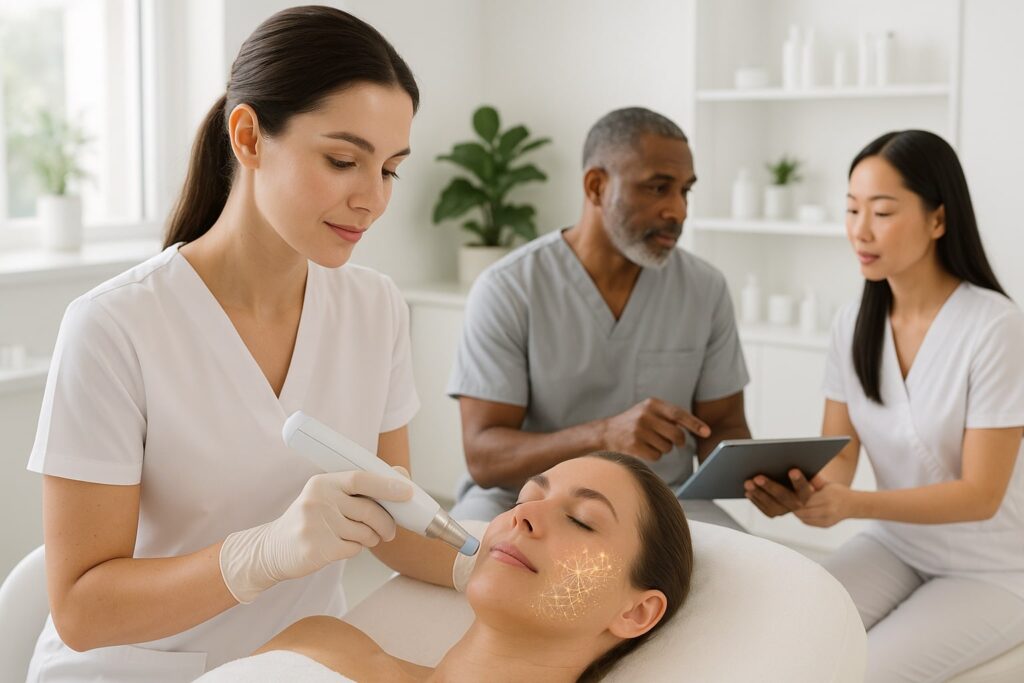
- Needle-free biostimulation refers to noninvasive treatments that support collagen production, skin renewal, and overall skin quality without injections.
- Demand is growing because many patients want lower-downtime options that fit long-term skin maintenance rather than aggressive correction.
- These treatments can be valuable, but they are not a direct replacement for injectables. Results tend to be more gradual and depend on consistency, skin condition, and treatment selection.
- Strong outcomes start with the basics: assessing barrier health, avoiding overly aggressive combinations, and setting realistic expectations.
- For estheticians, medical aesthetic assistants, and clinic teams, success depends on education, observation, and staying within the appropriate professional scope.
Needle-free biostimulation has become one of the most relevant shifts in modern medical aesthetics. For many patients, the appeal is straightforward: improve skin quality, texture, and radiance without injections, visible bruising, or significant downtime. For professionals, the bigger question is how to understand this category clearly and use it responsibly within an evidence-informed, patient-centered practice.
In the US market, this topic sits at the intersection of several larger trends: noninvasive skin rejuvenation, skin longevity, barrier-first care, and growing interest in maintenance-based treatment plans. That makes it especially important for estheticians, medical aesthetic assistants, and clinic leaders who want to build practical knowledge without overpromising what these treatments can do.
What needle-free biostimulation means in practice
Needle-free biostimulation describes noninvasive approaches designed to encourage the skin’s natural regenerative activity without using injectable products. In aesthetic settings, the goal is usually to support improvements in:
- Skin texture
- Tone and radiance
- Perceived firmness
- Overall skin quality
- Long-term maintenance of healthier-looking skin
Rather than placing material into the skin with a needle, these treatments rely on external technologies, topical formulations, or delivery systems that aim to stimulate a biological response more gently.
This matters because many people are not looking for dramatic change in a single visit. They are looking for a more gradual approach that fits preventative care, ongoing maintenance, or lower-intensity treatment plans.
How needle-free biostimulation works
At a high level, needle-free biostimulation is built around the idea that skin quality can improve when the skin is supported in a controlled, noninvasive way. Different modalities work through different mechanisms, but the general intent is similar: encourage renewal while preserving skin integrity.
The biological processes these treatments aim to support
Depending on the method used, needle-free biostimulation may help support:
- Collagen remodeling
- Surface-level cellular turnover
- Hydration balance
- Skin recovery processes
- A healthier-looking epidermal environment
That does not mean every treatment creates the same effect or the same level of change. The term covers a broad category, and clinical outcomes vary based on the modality, the patient’s skin status, and the consistency of care.
Why barrier health matters before any treatment
One of the most overlooked parts of treatment planning is skin barrier function. Even when a treatment is noninvasive, compromised skin can react poorly to stimulation.
If the barrier is already irritated, sensitized, or inflamed, treatment tolerance may be reduced and results may be less predictable. In professional practice, that is why barrier-first thinking is so important. A treatment may be technically noninvasive and still be a poor fit for skin that is not in a stable condition.
For educational purposes, this is one of the most important mindset shifts in modern aesthetics: gentler does not automatically mean appropriate for every patient, every day.
Why demand is rising in US aesthetic practices
The popularity of needle-free biostimulation is not just a passing trend. It reflects a broader change in how patients think about cosmetic care.
Patients want lower-downtime options
Many patients are interested in improving skin quality without the recovery profile associated with more invasive procedures. Common motivations include:
- Avoiding needles
- Minimizing redness or bruising
- Returning to normal activities quickly
- Starting with a more conservative treatment path
This is especially relevant in med spas, dermatology practices, plastic surgery clinics, and other aesthetic settings where patients often compare multiple treatment categories before deciding how far they want to go.
Skin longevity is replacing the “more is better” mindset
A growing number of patients are moving away from the idea that stronger always means better. Instead, they are interested in preserving skin quality over time.
That shift has made maintenance-focused treatments more attractive. Needle-free biostimulation fits well into this model because it can support a long-term strategy centered on consistency, prevention, and skin health rather than repeated aggressive intervention.
Sensitive and barrier-conscious patients need more options
Patients with reactive skin, post-inflammatory concerns, or a history of irritation often ask about treatments that feel more manageable. While not every noninvasive treatment is suitable for sensitive skin, the category offers more flexibility than procedures that rely on injections or significant tissue disruption.
Common modalities used in needle-free biostimulation
The category includes several types of treatments. The exact mix varies by practice, device availability, provider oversight, and state-specific scope-of-practice considerations.
Topical biostimulating formulations
Some practices use topical products intended to support renewal and improve visible skin quality. These may include:
- Peptide-based formulas
- Growth factor-oriented products
- Regenerative or recovery-focused serums
- Barrier-supportive companion care
Topicals alone are not interchangeable with device-based treatments, but they often play a supporting role in a broader skin program.
Energy-based technologies
Certain noninvasive devices are used to support skin rejuvenation without needles. Depending on the platform and indication, examples may include:
- Radiofrequency-based treatments
- Ultrasound-based technologies
- LED light therapy
These treatments differ significantly in how they work, what they are intended to address, and the type of supervision they require. In educational content, the key takeaway is not that all device categories are equal, but that they can be part of a needle-free strategy when selected appropriately.
Advanced delivery systems
Some systems are designed to improve product penetration without traditional injections. Examples often discussed in aesthetic education include:
- Electroporation
- Transdermal delivery technologies
- Other non-needle infusion approaches
These technologies are typically positioned as supportive tools for ingredient delivery rather than direct substitutes for injectables.
Needle-free biostimulation vs injectables
A common source of confusion is whether needle-free biostimulation is “better” than injectables. In most cases, that is the wrong comparison.
These options often serve different goals.
Needle-free biostimulation is generally more aligned with:
- Skin maintenance
- Early intervention
- Texture and quality support
- Patients who want a lower-intensity approach
- Ongoing care plans with minimal downtime
Injectables are often considered when the treatment goal involves changes that noninvasive care may not realistically achieve.
For clinics, the most responsible message is simple: these are not identical categories, and patients should not be led to expect injectable-like outcomes from a needle-free plan.
What results can realistically be expected
Expectation management is one of the most important parts of offering needle-free biostimulation responsibly.
In general, these treatments are better understood as gradual, cumulative, and maintenance-oriented. Patients may notice improvements related to skin feel, brightness, smoothness, or overall skin quality over time, especially when care is consistent and the plan matches the condition being treated.
What they should not be told is that one session will reliably deliver dramatic change or that a needle-free approach can replace every other treatment type.
A strong educational framework includes three ideas:
- Results are often incremental rather than immediate
- Consistency usually matters more than intensity
- Better skin quality often depends on both in-office care and appropriate home support
Who may be a good fit and when added caution is needed
Needle-free biostimulation is often explored for patients who want a conservative treatment path, are new to aesthetic care, or are focused on ongoing maintenance. It can also appeal to individuals who prefer noninvasive options as part of a broader skin strategy.
At the same time, added caution is often appropriate when skin shows signs of active irritation, recent over-treatment, impaired barrier function, or other issues that may affect tolerance. Selection and timing should always be guided by qualified professionals operating within applicable regulations and clinical oversight.
This is where patient education matters. A safer practice does not simply ask, “Can we do a treatment?” It asks, “Is this the right treatment for the skin in front of us right now?”
Common mistakes clinics make with needle-free biostimulation
Overstating speed or intensity of results
One of the most common mistakes is marketing these treatments as fast, dramatic alternatives to more invasive procedures. That sets the wrong expectation and can reduce patient trust.
Layering too many modalities at once
Because these treatments are noninvasive, teams may assume they can be stacked aggressively. But excessive combinations can still overwhelm the skin, especially in reactive or compromised patients.
Ignoring the condition of the skin barrier
Treating skin that is already sensitized is a common cause of poor tolerance. Barrier status should shape timing, product choice, and treatment pacing.
Using a one-size-fits-all treatment plan
Not every patient seeking collagen stimulation without needles has the same goals. Some want preventative care. Some want texture support. Others want recovery after prior aesthetic treatment. Clear treatment logic matters.
Failing to educate the patient
Patients often hear terms like “collagen stimulation” and assume dramatic restructuring. Without proper education, disappointment is more likely even when the treatment performs as expected.
How to introduce needle-free biostimulation into a practice responsibly
For clinics and aesthetic teams, successful implementation is less about trend adoption and more about operational discipline.
Start with assessment and treatment logic
Before offering any needle-free protocol, teams should evaluate:
- Visible skin condition
- History of irritation or sensitivity
- Barrier stability
- Current skincare use
- Recent aesthetic treatments
This does not require making sweeping promises. It requires matching the treatment category to the patient’s actual needs and current skin status.
Build protocols around progression, not aggression
A progressive plan usually performs better than an overly intense one. That means thinking in terms of repeatability, tolerance, and long-term skin support rather than trying to force a larger result in a shorter period.
Make patient education part of the treatment
Patients should understand:
- What the treatment is intended to improve
- What it is not designed to replace
- Why consistency matters
- Why home care and skin barrier support affect outcomes
When education is built in from the beginning, clinics often see better adherence and more realistic expectations.
Keep scope and supervision clear
In the US, who can perform which treatment varies by state, setting, licensure, and medical oversight model. For estheticians and medical aesthetic assistants, the priority is to work within legal scope, follow established protocols, and escalate concerns appropriately.
The role of estheticians and medical aesthetic assistants
Needle-free biostimulation is not only about technology. It is also about execution, observation, and continuity of care.
In many aesthetic practices, estheticians and medical aesthetic assistants help support success by:
- Preparing the skin appropriately
- Monitoring comfort and visible response
- Reinforcing aftercare and home-care instructions
- Tracking consistency across visits
- Noticing when the skin may need a lower-intensity approach
- Communicating findings to the supervising provider or clinic team
This role is especially important in maintenance-based care, where patient experience and treatment consistency often shape long-term satisfaction as much as the modality itself.
Why this category matters for the future of medical aesthetics
Needle-free biostimulation reflects a broader evolution in aesthetic care. Patients are increasingly interested in approaches that feel sustainable, balanced, and compatible with healthy skin function.
For professionals, that means the conversation is no longer just about what is possible. It is also about what is appropriate, tolerable, and aligned with long-term goals.
Clinics that understand this shift are usually better positioned to:
- Serve patients who are hesitant about invasive treatment
- Offer maintenance-oriented care more effectively
- Support skin quality without overselling intensity
- Build trust through clearer education and expectation setting
That is ultimately why this topic matters. It is not just a treatment trend. It is part of a larger move toward more thoughtful aesthetic decision-making.
Sources and references
- American Academy of Dermatology Association. Cosmetic procedures and skin care guidance.
- National Institute of Arthritis and Musculoskeletal and Skin Diseases. Skin structure and function overview.
- Avci P, Gupta A, Clark J, et al. Low-level laser therapy in skin: stimulating, healing, restoring. Seminars in Cutaneous Medicine and Surgery.
Explore evidence-informed aesthetics education
If you want to deepen your understanding of skin-focused treatment planning, noninvasive rejuvenation, and modern aesthetic practice trends, Eduasthetics offers educational content designed for professionals who value clarity, safety, and practical relevance.
FAQS
What is needle-free biostimulation?
Needle-free biostimulation is a noninvasive approach used in medical aesthetics to support skin renewal and collagen-related processes without injections. It may involve topical products, device-based treatments, or non-needle delivery systems.
Does needle-free biostimulation really stimulate collagen?
Some needle-free modalities are designed to support collagen remodeling or related regenerative responses, but results depend on the treatment type, the patient’s skin condition, and the consistency of care. It is best understood as a gradual skin-quality strategy rather than an instant transformation.
Is needle-free biostimulation better than injectables?
Not necessarily. The two categories often serve different purposes. Needle-free options are commonly used for maintenance, prevention, or skin-quality support, while injectables may be considered for goals that require a different treatment approach.
How many sessions are usually needed?
There is no universal number. Many noninvasive treatments are designed as a series or as part of an ongoing maintenance plan. Appropriate scheduling depends on the modality, the treatment goal, and the professional assessment.
Is needle-free biostimulation suitable for sensitive skin?
It can be a useful option for some patients seeking a lower-intensity approach, but sensitive skin still requires careful evaluation. A compromised barrier or active irritation may affect whether treatment should proceed and how conservative the plan should be.
What should a clinic assess before offering these treatments?
Aesthetic teams should consider skin condition, barrier health, current skincare use, sensitivity history, recent procedures, and the patient’s actual goals. Clear communication is just as important as treatment selection.
Related posts
Skincare ingredients that should not be combined in aesthetic practice
Ultrasound in aesthetics: uses, types, and when it may be considered
Mesotherapy in aesthetic medicine: what it means for facial, hair, and body treatments
Stay Updated
About de author
